Overview
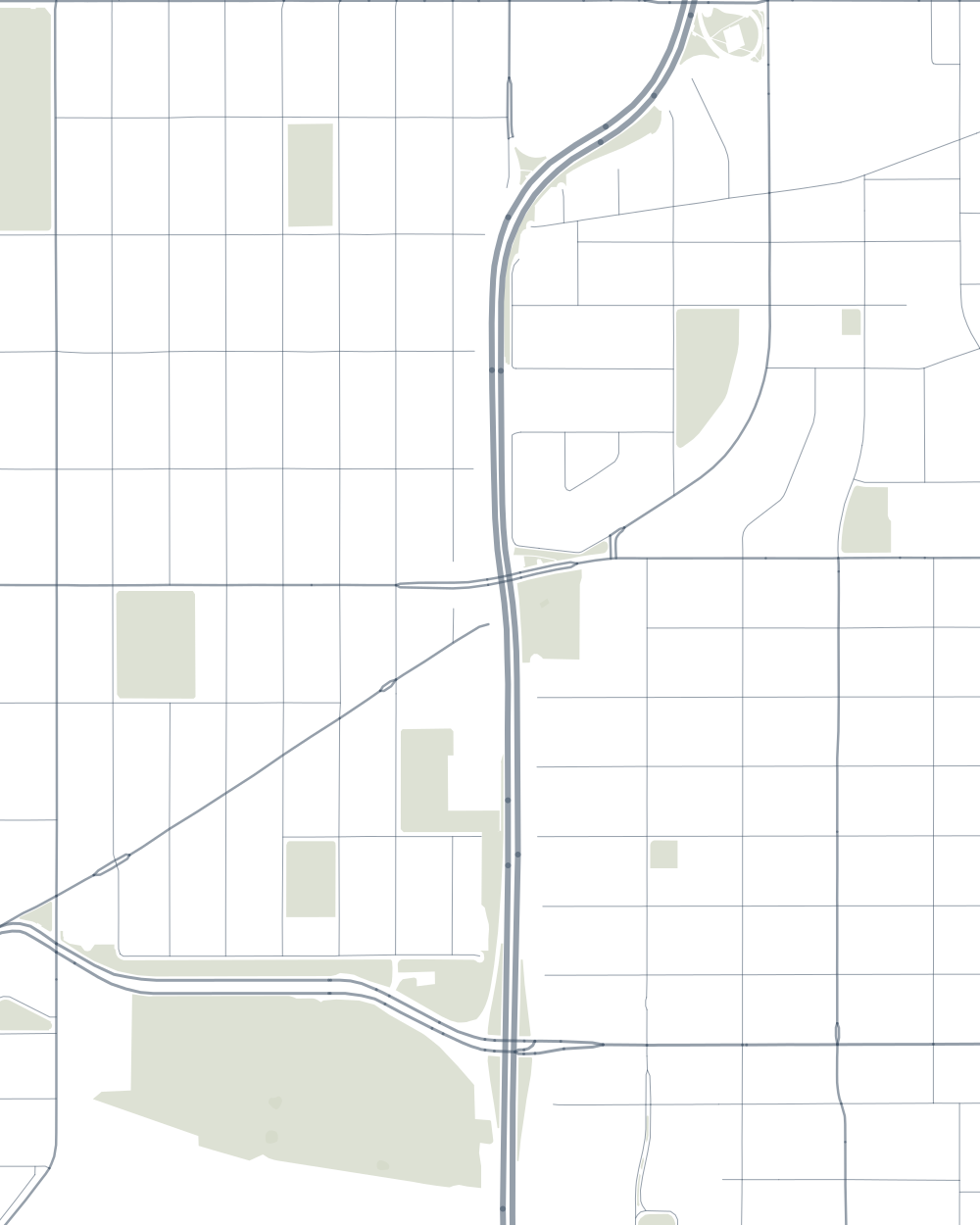
Richmond sits in the inner-city southwest quadrant directly west of Marda Loop and South Calgary. The community runs from 17th Avenue SW on the north down to 33rd Avenue SW on the south, with Richmond Road and 25A Street SW forming the western edge and 20th and 19th Streets SW the eastern one. Crowchild Trail South cuts straight through the middle rather than bounding it, which is part of why Richmond can feel like two halves. The community sits north of Currie and the former CFB Calgary lands across Richmond Road, and it shares its western edge with Killarney and its eastern edge with Bankview and South Calgary. Like its inner-SW peers, Richmond was built out in the post-war decades on a tight grid of 50-foot lots, and for most of its life it was a quiet community of mid-century bungalows. Over the last fifteen years that has changed faster here than almost anywhere in David’s footprint.
Richmond is today an active infill and teardown market. The original 1950s and 1960s bungalows are continually purchased, demolished, and replaced with modern product, and the dominant new form is the semi-detached duplex: two attached side-by-side homes on what was a single 50-foot lot. Pillar 9 recorded 131 residential sales in Richmond over the twelve months to August 2026. Detached houses led the count with 62 sales, 47.3% of the market, and a median of $991,250. Semi-detached homes closed 54 sales at a median of $1,000,000, above the detached figure. Row and townhouse product closed 11 at a median of $642,500, and the other four sales were apartments. The community reads as a working transition zone: original bungalows, half-finished blocks, and rows of three-year-old infills sharing the same streets.
What pulls buyers here is newer inner-city housing in a location that works on foot. Richmond gives the move-up family and the professional buyer a way into infill living on the west side of Marda Loop. You are a block from the 17th Avenue SW commercial strip, a short walk or cycle from the Marda Loop shops, roughly twelve minutes from downtown, and sitting on top of fast Crowchild and Bow Trail access. The trade-off is that this is a community in the middle of its rebuild rather than a finished, uniform streetscape, and the buyer who wants character permanence will find Richmond’s churn unsettling. The buyer who wants a new home in a proven inner-SW location finds it compelling.
David’s take
The vibe
Richmond reads as an inner-SW community in active transition. Walk any block and you will see the full arc of the community’s rebuild on a single street: an original 1958 bungalow with the owner still in it, an empty lot with a sold sign, a framed-up semi-detached pair, and a finished three-year-old infill with the landscaping just settling in. That churn is the defining texture of the community right now, and it cuts both ways. For buyers who want a new home it signals a healthy, liquid market in their product type. For buyers who want a settled streetscape it reads as unfinished.
The community draws its daily life from its edges rather than an internal commercial core. The 17th Avenue SW strip along the northern boundary is the everyday anchor: groceries, cafes, restaurants, pharmacies, and independent retail within an easy walk or cycle from most Richmond addresses. The Marda Loop commercial node to the southeast adds a denser, more destination-style mix of shops, restaurants, and services that has become one of inner-SW Calgary’s busiest walkable retail districts. Between the two, a Richmond resident covers most of daily life on foot or by bike.
The demographic mix has shifted with the housing stock. The original post-war family cohort has largely aged out, and the current resident profile skews toward move-up families and professional couples in the new infill product, with a thinning contingent of long-term bungalow owners and a steady flow of renters in the older stock and the small apartment cluster. Richmond/Knob Hill Park and the green space along the western and southern edges give the community its main outdoor footprint, and the proximity to the Currie redevelopment and the broader inner-SW pathway network extends the daily-life radius beyond the community’s own boundaries.
Housing stock
Richmond’s housing market is defined by its infill cycle, and detached houses and semi-detached duplexes are its two big property types. Detached houses were the larger of the two over the twelve months to August 2026, with 62 sales, 47.3% of the market, at a median of $991,250 between $520,000 and $2,200,000. The detached homes that sold had a median build year of 1990 and took a median of 24 days to sell. The group takes in original bungalows on 50-foot lots alongside detached infills, and it is the choice for buyers who want the privacy of a freehold detached home.
Semi-detached homes closed 54 sales at a median of $1,000,000, between $735,000 and $1,550,000, with a median build year of 2013 and a median of 33 days on market. These are the modern side-by-side infills built on former single bungalow lots, typically two-storey with developed basements, three or four bedrooms, and new mechanical systems.
Row and townhouse product closed 11 sales at a median of $642,500, below the detached and semi-detached medians, between $423,500 and $795,000. The median monthly fee was $304.69, the median build year was 2013, and the middle sale took 15 days, faster than the middle detached or semi-detached sale. It suits buyers who prioritise the inner-SW location over a detached house or a semi.
Apartments were four sales, too few for a reliable price, pace, fee or build-year figure. The three property types above add to 127 of the community’s 131 sales, and the four apartment sales are the difference.
| Type | Typical price | Notes |
|---|---|---|
| Detached | $991,250 | 62 sales (47% of all sales in the community) between $520,000 and $2,200,000. Half sold within 24 days. Typical build year 1990. |
| Semi-detached | $1,000,000 | 54 sales between $735,000 and $1,550,000. Half sold within 33 days. Typical build year 2013. |
| Row / townhouse | $642,500 | 11 sales between $423,500 and $795,000. Half sold within 15 days. Typical condo fee $305 a month, typical build year 2013. |
| Apartment | Too few sales | Only 4 sales, not enough for a reliable price. |
Recent sales
Over the twelve months to August 2026, the middle Richmond sale took 29 days to sell. The average was 41 days, the figure shown at the top of the page. By property type, row and townhouse product took a median of 15 days, detached houses 24 and semi-detached homes 33.
The median sale closed at 97.86% of its list price.
Richmond’s median sale price was $920,000. The header’s $994,045 is the average across all 131 sales, $74,045 above that median.
Half of all sales closed between $795,000 and $1,186,500.
Sales ran from $186,500 to $2,200,000. The top is a detached sale. The low sits among sales too few to price, so read it as the true bottom of the community’s range and nothing more.
Selling a Richmond home starts with a home valuation on your address. Buying one starts with the buyer’s guide, which explains how conditions and offers work.
Schools
Schools are a working consideration for Richmond families, and the inner-city picture comes with the usual caveat that boundaries can shift and need confirming address by address. Richmond School is the in-community CBE elementary for part of Richmond. Other addresses designate to Glendale School, Glenbrook School or Alexander Ferguson School, and from the 2026-27 school year, Richmond School’s addresses west of Crowchild Trail SW were re-designated to Glendale School. The CBE junior high varies by address: Mount Royal School, A. E. Cross School or Vincent Massey School. For senior high, Central Memorial High School at 5111 21 Street SW is the designated CBE school for Richmond addresses.
For Catholic families, part of Richmond designates to Sacred Heart School and then St. Monica School in Mission, and the rest to St. Thomas Aquinas School and then St. Gregory School, with St. Mary’s High School on 18 Avenue SW the senior high. From the 2027-28 school year, the designated Catholic senior high for the part of Richmond west of Crowchild Trail becomes St. Pier Giorgio Frassati High School, the new CSSD school in west Calgary due to open in fall 2027. The CSSD manages its boundaries independently of the CBE, so the picture for a Catholic family can differ block by block.
Because Richmond sits in the inner city where boundaries are redrawn more often than in established suburban communities, the CBE Find a School and CSSD Attendance Areas tools are the only reliable way to confirm which schools apply to a specific address. Run them before a purchase if school catchment is part of the decision, rather than relying on the community-level pattern described here.
Richmond School
Public · K-6
The in-community CBE elementary for part of Richmond. Other addresses designate to Glendale School, Glenbrook School or Alexander Ferguson School, and from the 2026-27 school year, Richmond School's addresses west of Crowchild Trail SW were re-designated to Glendale School. Confirm exact boundaries with the CBE Find a School tool before relying on it for a purchase decision.
Mount Royal School
Public · 7-9
The CBE junior high varies by address: Mount Royal School, A. E. Cross School or Vincent Massey School. Confirm exact boundaries with the CBE Find a School tool before relying on it for a purchase decision.
Central Memorial High School
Public · 10-12
The designated CBE senior high at 5111 21 Street SW that Richmond students attend. Confirm exact boundaries with the CBE Find a School tool before relying on it for a purchase decision.
St. Monica School
Catholic · K-9
A CSSD K-9 school in Mission, the designated Catholic junior high for part of Richmond, with Sacred Heart School for the elementary years; other addresses designate to St. Thomas Aquinas School and St. Gregory School. Confirm exact boundaries with the CSSD Attendance Areas tool before relying on it for a purchase decision.
St. Mary's High School
Catholic · 10-12
The inner-city CSSD Catholic senior high on 18 Avenue SW that serves the Richmond Catholic pathway. From the 2027-28 school year, the designated Catholic senior high for the part of Richmond west of Crowchild Trail becomes St. Pier Giorgio Frassati High School, the new CSSD school in west Calgary due to open in fall 2027. Confirm exact boundaries with the CSSD Attendance Areas tool before relying on it for a purchase decision.
Getting around
Richmond’s location is one of its strongest selling points, and the road network is shaped by two arterials. Crowchild Trail, which cuts through the middle of the community, is a high-speed arterial that connects the community north to the University of Calgary, Foothills Medical Centre, and the northwest, and south to Glenmore Trail and the ring road. The 17th Avenue SW corridor along the northern edge is the inner-city connector that carries traffic east into the Beltline and downtown and west toward Killarney and beyond. Away from those corridors, Richmond is a quiet residential grid with rear-lane access on most blocks, keeping daily-life traffic off the sidewalk.
Downtown is approximately 12 minutes by car outside peak hours via 17th Avenue SW or Bow Trail, which is among the shorter inner-SW commutes in David’s footprint. The University of Calgary and Foothills Medical Centre are both reachable in roughly 10 to 12 minutes via Crowchild Trail north, which makes Richmond a genuinely practical option for the two-career household where one partner works in the core and the other in the university or hospital district. Calgary International Airport is approximately 25 minutes via Crowchild and the connecting routes to Deerfoot Trail.
Transit and active-mode access are strong for an established community. The 17th Avenue SW MAX BRT line runs along the northern boundary with stops at the edge of the community, and several Calgary Transit bus routes connect Richmond to the broader network and to the West LRT at Westbrook a short distance to the northwest. The 17th Avenue and Marda Loop commercial strips are walkable or cyclable from most addresses, and the inner-SW cycling network connects Richmond to the Bow River pathway and the wider city. Most Richmond residents commute by car, and the network supports that pattern well, but the walkable retail and the BRT option give the community genuine car-light flexibility that many inner-SW addresses cannot match.
The honest note on the arterials is the trade-off they bring. Crowchild Trail and 17th Avenue SW are what give Richmond its commute speed and its walkable retail, but properties that front or back to those corridors are exposed to arterial noise. The rest of the grid is quiet residential, and the noise dynamic is contained to the blocks along them, but it is worth checking each address individually if the lot fronts or backs to Crowchild or 17th Avenue.
Frequently asked questions
Why is Richmond also called Knob Hill?
Richmond and Knob Hill were originally two adjacent communities that the City of Calgary now administers as a single combined community. Richmond/Knob Hill is the name of the community association; the City’s community boundary and Pillar 9’s MLS subdivision both use Richmond. If you are searching sold data or school catchments, try both names so you see the full picture.
Is Richmond mostly infill duplexes now?
Not by count. Richmond is an active teardown market. Mid-century bungalows on 50-foot lots are continually subdivided and replaced with modern semi-detached pairs, but over the twelve months to August 2026 detached houses were the largest property type, with 62 sales at a $991,250 median, against 54 semi-detached sales at a $1,000,000 median. Original bungalows still exist, but most are bought as teardown or major-renovation candidates rather than as long-term character homes.
How do Richmond prices compare with Altadore and Marda Loop?
It depends on the property type. Measured the same way over the same window, the twelve months to August 2026, the detached median was $991,250 in Richmond, $1,048,750 in South Calgary, the official community name for Marda Loop, and $1,390,000 in Altadore. Semi-detached homes ran in a different order: $900,000 in South Calgary, $1,000,000 in Richmond and $1,141,500 in Altadore. The communities share post-war origins, the same infill cycle, and similar walkability to 17th Avenue and the Marda Loop strip.
Should I buy a new infill or an original bungalow in Richmond?
It comes down to whether you want to move in or to build. A modern semi-detached infill gives you new mechanical systems, a developed basement, and a home that’s ready to live in. Semi-detached homes sold at a median of $1,000,000 over the twelve months to August 2026, and that figure takes in semis of every age, not only new ones. An original bungalow is usually a teardown or major-renovation play, so its purchase price is only the first cost, and the build or the renovation comes on top of it. Buy the bungalow if you genuinely want to build or fully renovate; buy the finished infill if you want to move in and live. David can walk through the specific math on a property-by-property basis.
What are the school catchments for Richmond?
Richmond School is the in-community CBE elementary for part of Richmond. Other addresses designate to Glendale School, Glenbrook School or Alexander Ferguson School, and from the 2026-27 school year, Richmond School’s addresses west of Crowchild Trail SW were re-designated to Glendale School. The CBE junior high varies by address: Mount Royal School, A. E. Cross School or Vincent Massey School. Central Memorial High School at 5111 21 Street SW is the designated senior high. For Catholic families, part of Richmond designates to Sacred Heart School and then St. Monica School in Mission, and the rest to St. Thomas Aquinas School and then St. Gregory School, with St. Mary’s High School on 18 Avenue SW the senior high. From the 2027-28 school year, the designated Catholic senior high for the part of Richmond west of Crowchild Trail becomes St. Pier Giorgio Frassati High School, the new CSSD school in west Calgary due to open in fall 2027. Boundaries shift in inner-city communities, so confirm any specific address against the CBE Find a School and CSSD Attendance Areas tools before relying on a catchment for a purchase decision.
How walkable is Richmond, and how is the commute downtown?
Richmond is genuinely walkable for an established residential community. The 17th Avenue SW commercial strip runs along the northern edge with groceries, cafes, and restaurants, and the Marda Loop shops are a short walk or cycle to the southeast. Downtown is roughly 12 minutes by car outside peak hours via 17th Avenue or Bow Trail, and Crowchild Trail gives fast access to the University of Calgary and Foothills Medical Centre, both about 10 to 12 minutes. The 17th Avenue SW MAX BRT line and several bus routes serve the area, though most residents commute by car.
Is the Richmond apartment market a good entry point?
It’s hard to say from the sales. Only four apartment units sold in Richmond over the twelve months to August 2026, too few to read a typical price, selling time or sale-to-list figure from. Row and townhouse product, 11 sales, sold at a median of $642,500, below the detached and semi-detached medians, with a median monthly fee of $304.69. Condo document due diligence matters on either one.
How close to asking do Richmond homes sell, and how fast?
Over the twelve months to August 2026, the median Richmond sale closed at 97.86% of its list price. Pace depended on the property type. Row and townhouse product took a median of 15 days, detached houses a median of 24 days, and semi-detached homes 33, the longest of the three. Community-wide, the middle sale took 29 days and the average was 41, which is the figure in the header.
Sales data current as of 2026-08-31. Includes 131 residential sales in Richmond over the twelve months to August 2026. Source: Pillar 9 MLS® System. Copyright 2026 Pillar 9. All Rights Reserved.
Commute times
| Downtown | 12 min |
|---|---|
| University of Calgary | 12 min |
| Foothills Hospital | 10 min |
| Airport (YYC) | 25 min |