Overview
McKenzie Towne answers the question buyers actually ask about a compulsory fee, which is not what it costs this year but whether it moves. The McKenzie Towne Council publishes a seven-year schedule of its annual fee: $220.00 effective June 1 in 2020 and again in 2021, $226.60 effective June 1, 2022 and held at that figure for 2023, 2024 and 2025, then $235.00 effective June 1, 2026. Four years unchanged, then a step of $8.40, about 3.7%. From the first year on the schedule to the last, the fee rose $15.00, about 6.8%. Those percentages are arithmetic on the Council’s own published figures.
Two things about the current number. It is a single flat rate for the whole community, published with no property-type schedule beside it. And the GST is already inside it: the Council’s sample 2026 invoice shows a sub total of $223.81 plus $11.19 GST for a total of $235.00, and its payment page tells members sending an e-transfer to send the total including GST. What the schedule does not give you is a policy. The Council publishes no escalator, no formula and no cap, so the history is a record of where the fee has been rather than a projection of where it goes next.
The obligation is registered against the land. An encumbrance is filed on each title under Alberta’s Land Titles Act, membership in the Council is automatic and mandatory on purchase, and the Council’s FAQ answers the opt-out question with a flat no. Article 4 of the Articles of Association is the paragraph a condominium or commercial buyer should read, because it requires every owner of a single family or multi-family residential property, expressly including a condominium unit with its own certificate of title, and every owner of a commercial development, to be a member. There is no exclusion list in McKenzie Towne.
What the fee attaches to is a community the City of Calgary describes in a statutory document. The Revised East McKenzie Area Structure Plan calls McKenzie Towne a neotraditionally-designed community comprised of four separate residential neighbourhoods and a commercial towne centre, and notes that the design has led to roadway, servicing and architectural standards unique to it. The plan is candid about whose idea it was: the neotraditional concept McKenzie Towne is based upon is largely developer initiated, and the plan declines to impose the same philosophy on the neighbouring communities of New Brighton and Copperfield. Carma Developers received land use approval for the initial stages in 1994, the first village opened in 1995, and the Council describes the community as developed in 1995 with a different concept from other communities in mind.
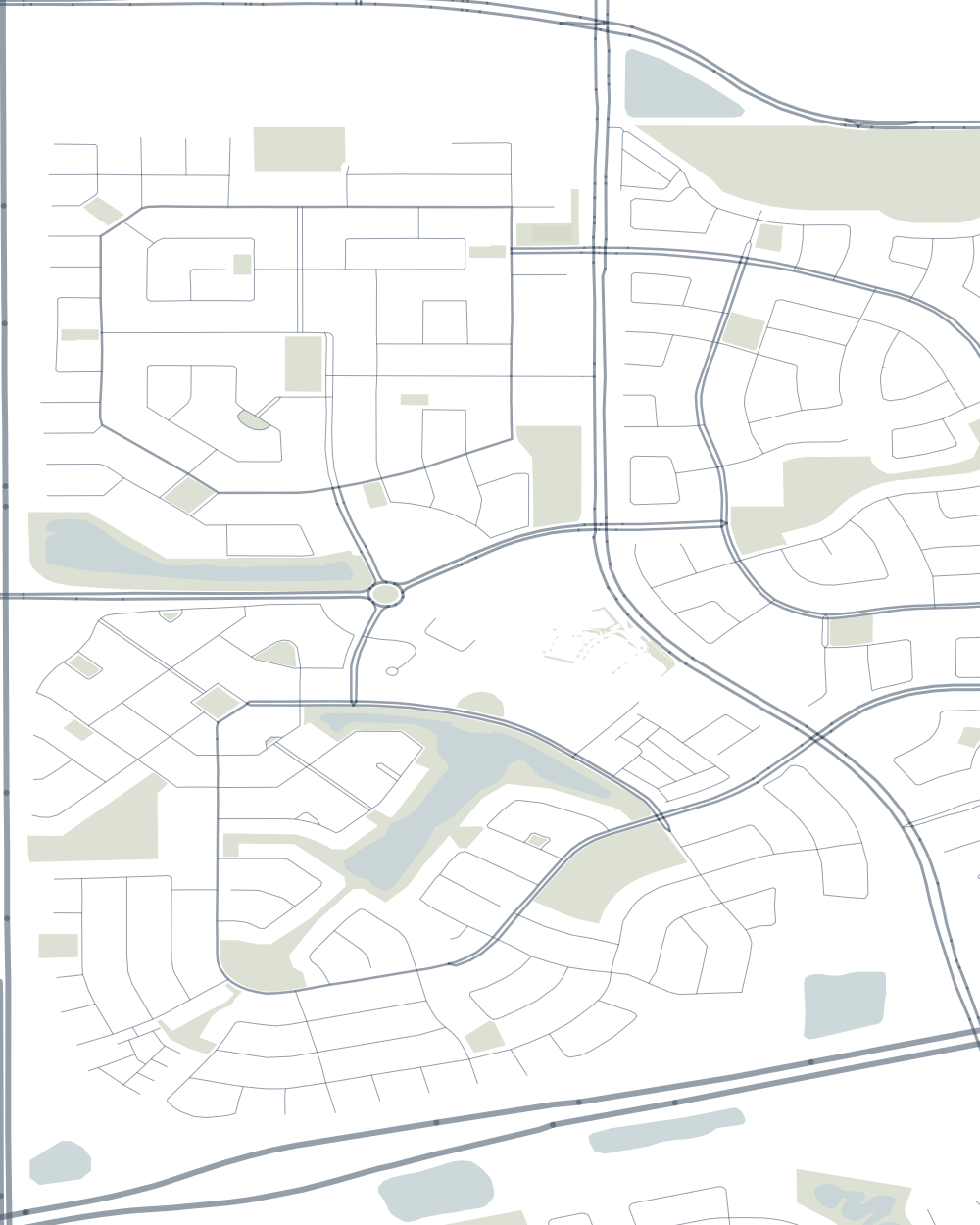
The City places McKenzie Towne in its southeast sector, in Ward 12, whose councillor is Mike Jamieson. The Area Structure Plan gives a gross developable area of 962 acres, or 389 hectares. On where the edges fall, the clearest published description comes from the Council’s own Articles, which define the McKenzie Towne Lands as the residential subdivision lands east of Deerfoot Trail, west of 52nd Street SE, north of Highway 22X and south of the South Trail Crossing property line. Read that for what it is: the association’s definition of the ground its encumbrance covers, which is not necessarily identical to the community boundary the City draws. The newest official population count is 17,505, from the 2021 Census of Canada, alongside 6,955 occupied private dwellings, and Calgary’s civic census was discontinued after 2019 so there is nothing more recent to reach for. An older civic count sits higher than the federal one, but the two use different methods and different definitions of who is counted, so the difference between them is not evidence of anything. A separate figure corroborates the dwelling count from an entirely different direction: the Council states that it manages 6,700 properties, which lands within about 4% of the census total.
The market is where this community stops resembling the shape a buyer expects from a fee-bearing suburb. McKenzie Towne recorded 368 residential sales over the twelve months to August 2026, and detached houses were 167 of them, 45.4%. The three attached segments together were 201 sales, 54.6%. No single product held a majority here, which changes how the blended median of $479,600 should be read, and the Housing stock section takes the four apart.
David’s take
The vibe
The clearest account of what the Council’s fee buys is not on its marketing pages. It is in Exhibit 2 to its Articles of Association, a legal schedule that lists the amenities item by item, down to 266 linear feet of ornamental wrought-iron fence at one park and twelve tree-bed electrical outlets at another.
That list divides in two, and the division is the whole story. Four things the Council owns outright: a 1.5 acre landscaped park with an entrance feature and an electronic community message board beside the traffic circle at McKenzie Towne Boulevard SE and Inverness Gate SE; McKenzie Towne Hall at 40 McKenzie Towne Blvd SE; a mail pick-up area inside the Inverness Square commercial building reserved to members under a lease, with Canada Post granted access; and a clock in that same building, held under a named Clock Tower Lease. Everything else in the schedule is a City-owned public park where the Council pays to maintain built features. The Council explains why in plain words on its own site: the City of Calgary does not accept responsibility for maintaining these amenities and would remove them if the Council did not take care of them.
Exhibit 2 runs to fifteen numbered entries, fourteen of them named and carrying the City’s own park number, with the fifteenth covering unnamed signage on City medians and boulevards. The exhibit says the amenities include but are not limited to what it lists, so read it as a floor rather than a live inventory. The features in it are the ones a resident walks past. Elgin Hill Park carries stone columns and archways and a Rundle Stone Ruin Wall. Prestwick Common Park carries a fountain, a fire pit, arbours, entry stone columns and pole lamps. Promenade Park and Look Out Park carry a gazebo and games table, a horseshoe pit and a shuffleboard court, three flagpoles and marine-style lights on the lookout. Inuksuk Park has four inuksuit. Butterfly Park has a butterfly sculpture and a stone plaque. Trike Towne has stop signs, traffic circle signs and winding path signs. Draw Bridge Park has a Rundle Draw Bridge entrance feature with brickwork and chains, which is a separate object from the ruin wall and sits in a separate park.
The Ruins, which the Council itself writes in quotation marks, are worth one correction. They are not ruins. Exhibit 2 names the object as a Rundle Stone Ruin Wall, a built stone folly maintained alongside the columns and archways at Elgin Hill, and Elgin Hill also carries a toboggan run. Nothing there is the remains of anything.
The water is drainage, not recreation
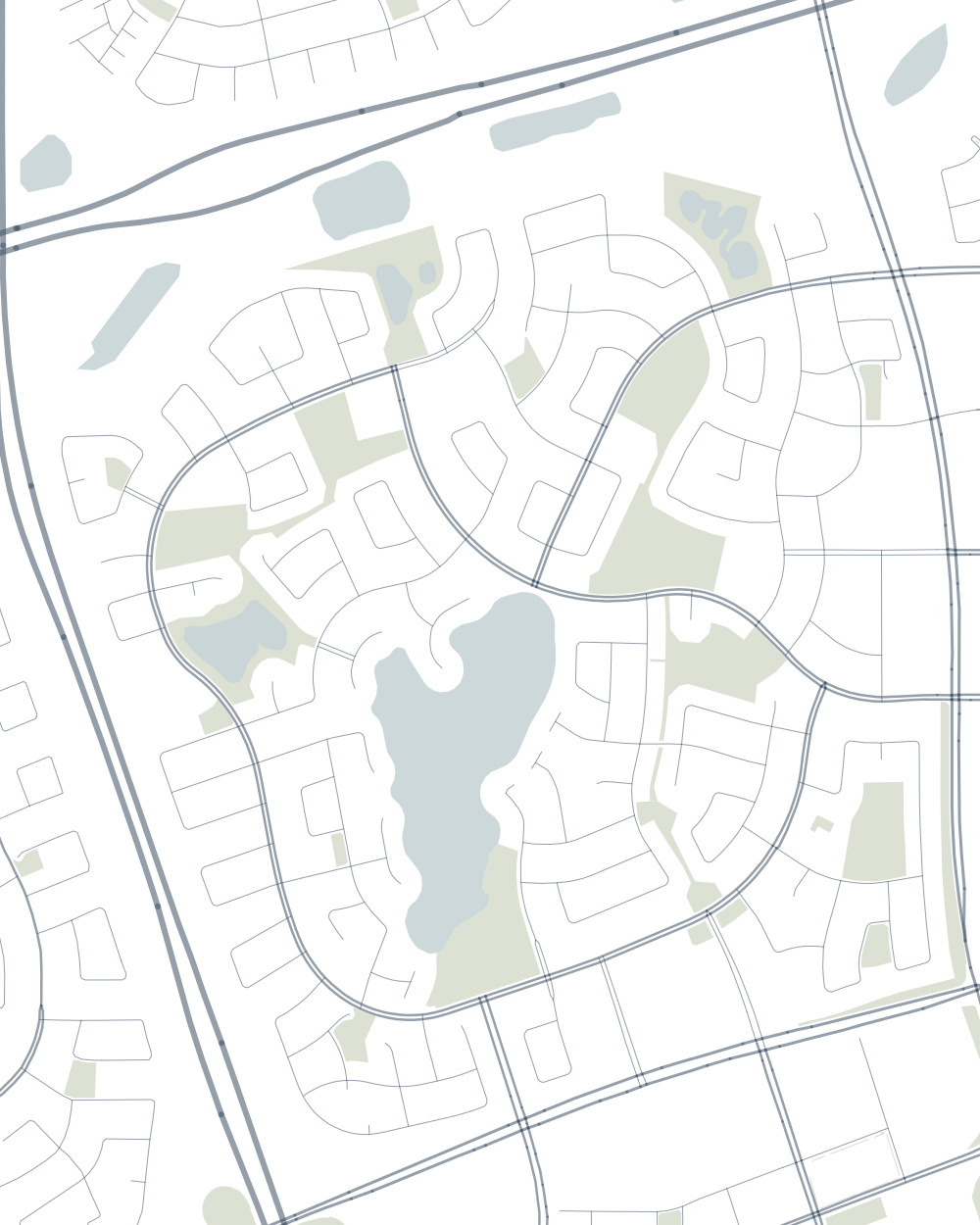
This is the easiest thing in McKenzie Towne to get wrong. The community has two ponds, Prestwick and Inverness, and both are storm water retention ponds put in place for community drainage purposes only. The Council states there is no access to the water and that no swimming, boating or skating is allowed, and it puts the instruction in capitals: do not skate on the Prestwick or Inverness storm ponds.
What is usable is the pathway around each, and the Council publishes both lengths. The Prestwick pond, on the north side of McKenzie Towne Boulevard, has a loop of 1.5 kilometres. The Inverness pond, south of Promenade Way, has a loop of 2.37 kilometres. Snow and ice are removed from both in winter, so the loops stay walkable year-round.
Skating does happen here, on rinks. The City of Calgary makes the ice on Prestwick Common and the hockey rink surfaces, flooding them when operational capacity allows and when the temperature is below minus 10 degrees Celsius at the time of flooding. Prestwick Fountain Park is published as offering skating, fire pits and tobogganing in winter. The ponds are infrastructure; the rinks are the amenity.
The names, and one framing that circulates and is wrong
McKenzie Towne was built out in named phases and the naming has been garbled in a lot of places, so here is what the primary documents support. The City’s Area Structure Plan names Inverness as the initial neighbourhood, approved in 1994. The Council’s own Articles use Elgin Village and Prestwick as formal phase descriptors, attached to phase numbers in Exhibit 2. The plan counts four separate residential neighbourhoods and names only Inverness, referring elsewhere to an unnamed Neighbourhood 4 in the southeast corner, so the fourth is not named on this page because no source names it.
The formulation that circulates online, dividing McKenzie Towne into Inverness, Elgin, Prestwick and High Street, is wrong on its own terms. High Street is a commercial street, and the City’s count of four residential neighbourhoods excludes the towne centre entirely.
What High Street is, in the City’s words, is the traditional main street of a commercial towne centre central to the East McKenzie area, characterised by curb parking, front facing retail shops and pedestrian amenities. The plan distinguishes it from a second, separate commercial centre: a regional centre along 130 Avenue SE on the north side of the community. Those are two different kinds of shopping and it is useful to know which one a listing means. The City does not publish a count of businesses on High Street, or the year it opened. High Street is also not one of the City’s fifteen Business Improvement Areas.
The Hall, and what the fee does not buy
McKenzie Towne Hall at 40 McKenzie Towne Blvd SE is the Council’s own building and the address on its invoices. Its three bookable rooms are named for the phases: the Elgin Room at 485 square feet, the Prestwick Room at 715 and the Inverness Room at 865, seated capacities of 20, 40 and 50 respectively. Booked together as a full banquet the floor area does add up, to 2,065 square feet. The seating does not, and it is worth saying why rather than leaving a reader to check the sum. The Council publishes the full banquet at 125 seated, which is fifteen more than the three rooms manage separately, because taking the divisions out yields usable floor that the individual configurations lose. Standing capacity for that combined room is published at 155. There is also a gymnasium with drop-in programming. The Council says its fee funds the operation and administration of the Hall along with capital spending, and that it has spent more than $5 million on capital assets around the community over the past fifteen years, with audited financial statements going to every member before the annual general meeting.
Two boundaries on that spending are worth knowing before you form an expectation. Trees are explicitly not the Council’s responsibility, although it says it is partnering with the City on green-cover initiatives. And McKenzie Towne is ungated: the Council states plainly that the community welcomes residents and non-residents alike to enjoy all of its parks. The fee does not buy exclusive access to anything outdoors. Where it does gate access is the Hall and its activities, since rights to the amenities are subject to automatic suspension for default in payment, and that suspension cascades to a tenant or family member who derives access through the owner.
Two bodies, one of which you can decline
Two organisations carry this community’s name and only one of them can bill you. The McKenzie Towne Council is a private not-for-profit residents association incorporated under Alberta’s Companies Act, professionally managed with paid staff, and funded by the fee on every title. The McKenzie Towne Community Association is the one you can decline: entirely volunteer based, funded by membership fees, fundraising and sponsorship, and charging $10 a year for residents and $15 for non-residents. The Council maintains the amenities, the Hall and the programming inside it. The community association represents residents to all levels of government on city and traffic matters, zoning and public property issues, and hosts events outside the Hall.
One terminology note saves a fruitless search. The Council itself says the labels are used loosely, with homeowners association and residents association often used interchangeably. This body calls itself a Council, brands its fee page HOA Fees, and is legally a residents association. Someone searching McKenzie Towne HOA and someone searching McKenzie Towne RA are looking for the same $235.00. Governance is a volunteer board elected annually at the AGM, with quorum set at the lesser of fifty members in good standing or ten percent of them, and the bylaws and financial statements are published on the Council’s public website rather than behind a member login.
Housing stock
Three of the four segments here are attached product, and together they were the larger half of the market. Eighty-eight row and townhouse sales, eighty apartment sales and thirty-three semi-detached sales come to 201 of the 368 sales, against 167 detached. That is 54.6% against 45.4%, and it is the fact that governs how every community-wide figure on this page should be read.
Age is the second structural fact and the City’s own construction table settles it. Of McKenzie Towne’s 6,955 occupied private dwellings at the 2021 census, 4,305 went up between 2001 and 2010 and 1,380 between 1991 and 2000, which is 62% and 20%, so 82% of the stock dates from the twenty years to 2010. A further 1,055 date from 2011 to 2015, and only 70 from 2016 to 2021, which is 1%. A small number of homes date from before 1991. This is a community that finished building, and the sales agree: the homes that changed hands over the twelve months to August 2026 had a typical build year of 2005.
Taking the four segments from the least expensive upward:
Apartments were 80 sales, 21.7% of the market, typically $275,000 (average $282,013), between $175,000 and $575,000. That $175,000 low is also the lowest sale in the whole community, and the $575,000 high sits above the top of the row and townhouse segment, so the two attached condo types overlap rather than stacking cleanly. Half of these apartments sold within 31 days, though the average was slower at 44, the slowest average of the four segments. Typical build year was 2006, and the typical condo fee was $470.00 a month, reported on every one of the 80 sales.
Row and townhouse product was 88 sales, 23.9% of the market, typically $400,111 (average $397,649), between $273,000 and $510,000. This is the only one of the four where the average sits below the typical price, by about $2,500, pointing to a few lower-priced sales pulling the average down. Half of these sold within 33 days, the slowest of the four by that measure, though the average was 42. Typical build year was 2005, and the typical condo fee was $382.00 a month, reported on every one of the 88 sales.
Semi-detached homes were 33 sales, 9.0% of the market, typically $478,000 (average $483,597), between $433,500 and $559,000, the narrowest range of the four. Half sold within 21 days, though the average was 31. This is the newest-built segment of the four, with a typical build year of 2007. Too few of these sales reported a condo fee to publish one. One coincidence is worth naming so nobody reads a signal into it: this segment’s typical price of $478,000 sits just $1,600 from the community-wide typical price of $479,600, closer than any of the other three, and it is also the smallest segment on the page. That is a coincidence of the mix, not a sign that semi-detached homes describe this market.
Detached houses were 167 sales, 45.4% of the market, typically $610,000 (average $630,046), between $460,000 and $1,380,000, the widest range of the four and the one that contains the community’s top sale. Half sold within 21 days, though the average was 30. This is the oldest-built segment of the four, with a typical build year of 2003. No condo fee applies to this segment.
One carrying cost applies to all four regardless of segment. The annual McKenzie Towne Council fee attaches to every title through the encumbrance, condominium titles included, and a condominium fee sits on top of it rather than in place of it.
| Type | Typical price | Notes |
|---|---|---|
| Apartment | $275,000 | 80 sales (21.7% of the market) between $175,000 and $575,000. Half sold within 31 days. Typical condo fee $470 a month, typical build year 2006. |
| Row / townhouse | $400,111 | 88 sales (23.9% of the market) between $273,000 and $510,000. Half sold within 33 days. Typical condo fee $382 a month, typical build year 2005. |
| Semi-detached | $478,000 | 33 sales (9.0% of the market) between $433,500 and $559,000. Half sold within 21 days. Typical build year 2007. |
| Detached | $610,000 | 167 sales (45.4% of the market) between $460,000 and $1,380,000. Half sold within 21 days. Typical build year 2003. |
Recent sales
Take the two ends first, because they sit in different segments and neither one is anywhere near the middle. The least expensive sale in McKenzie Towne over the twelve months to August 2026 closed at $175,000 and it was an apartment. The most expensive closed at $1,380,000 and it was a detached house. Between them, half of all 368 sales closed between $350,000 and $592,500, and the middle sale closed at $479,600.
The two community-wide numbers barely differ. The average sale price across all 368 sales was $485,680, the figure shown in the stat block at the top of this page, and it sits $6,080 above the typical price of $479,600, about 1.3% higher. That gap stays small because McKenzie Towne’s most expensive sales are not big enough or common enough to pull the average away from the middle of the market. Inside the detached segment the gap is wider, at $20,046, and the segment notes above cover where each type lands.
Speed of sale varied by segment. Detached and semi-detached homes tied for fastest, with half selling within 21 days. Apartments took a bit longer, with half selling within 31 days, and row and townhouse product was slowest, with half selling within 33 days. Looking at averages instead, the order shifts slightly: detached averaged 30 days, semi-detached 31, row and townhouse 42, and apartments 44. Across the whole community, half of all sales closed within 25 days, with an average of 36 days, about 44% higher.
Sellers came close to asking price across the board: typically 98.21% of asking, and 98.27% on average, both well within a percent of full price.
Every community-wide number on this page blends four very different types of home, and here no single type is common enough to represent the whole market on its own. The segment table above is a better starting point than any single community-wide figure. To place a specific home inside those bands, start with the buyer’s guide. On the selling side, a home valuation is the first step.
Getting around
McKenzie Towne has transit infrastructure sitting inside it today, and that belongs ahead of the Green Line conversation rather than behind it. McKenzie Terminal is a working bus terminal on 52 Street SE inside the community boundary, with stops in both directions, and Calgary Transit publishes a McKenzie Towne park and ride of 522 free stalls and 8 accessible stalls. It appears in the non-LRT section of the City’s park and ride list, because it is served by buses rather than by a train.
Eight routes have stops inside the boundary. Route 92 McKenzie Towne carries 44 of them, more than any other route serving the community, and it is the connection to the Red Line at Anderson Station. Route 117 McKenzie Towne Express carries 38 stops inside and runs downtown without a transfer, with 14 stops in the Downtown Commercial Core, two in Downtown West End and one in Downtown East Village. Route 151 New Brighton Express reaches downtown directly as well, with five stops inside the community. Route 302 BRT Southeast/City Centre has five stops inside, including both directions at McKenzie Terminal, and reaches the Downtown Commercial Core and Downtown East Village; the City files it under bus rapid transit, which is a separate category from the colour-branded MAX network, and nothing in the MAX category stops anywhere within this community’s boundary. Route 23 52 St E has nine stops inside and reaches both Saddletowne Terminal on the Blue Line and McKenzie Terminal. Route 152 New Brighton, Route 153 Copperfield and Route 406 Stampede South East Express complete the eight. One caution on 406: its name suggests a seasonal service, but the City’s data classes it as a regular route, and its service period is not published.
The Green Line is where this community is easiest to misread, and the error runs in a direction that flatters it.
Two stations carrying McKenzie Towne’s own names appear on Green Line maps inside the community. Prestwick station sits inside the community boundary, 33 metres from the nearest edge, and McKenzie Towne station sits inside it 34 metres from the nearest edge, coincident with the existing McKenzie Terminal. Both belong to the unfunded future extension. The City’s open data records both at a construction stage of TBD, and no start date, no opening date and no funding commitment is published for either.
The station that is funded carries a different name and sits outside the community. Shepard is 449 metres beyond the boundary, measured as a straight line from the station point to the nearest point on the community boundary, and it is the southern terminus of the funded Phase 1. Construction of the southeast segment began in June 2025 and the line is published as opening in 2031. The station is at a different stage from the line and the two should not be run together: Shepard’s design reached its 90% milestone in December 2025, and the City’s own station page states that only fine tuning remains before construction can begin. The line is being built. The station has not started. Shepard is planned with a park and ride of approximately 920 stalls, and the City names McKenzie Towne, Copperfield and New Brighton as the communities near it.
The nearest station that exists today is Somerset-Bridlewood on the Red Line, 6,571 metres from the boundary in a straight line, with Canyon Meadows at 6,623 metres and Shawnessy at 6,674 metres. At the ends of the routes that serve the community, Anderson has 1,651 free stalls, 81 reserved, nine four-hour and nine accessible, and Saddletowne has 75 free, 40 reserved, ten four-hour and five accessible.
Two dates on this subject have a shorter shelf life than anything else on the page. Council instructed staff on June 30, 2026 to evaluate alternatives for the Downtown Segment, with that work due back at Executive Committee on September 8, 2026. Shepard’s design milestone is stamped December 2025. Either could have moved by the time you read this, so the City’s own Green Line pages are the place to settle it.
No community-level drive time is published, so time your own route on a live map, at the hour you’d drive it. Every metre quoted above is a straight line to a community boundary, not a walking distance, so no walking time is given either. For current bus frequency, check Calgary Transit’s live schedule. Make the trip once, on a working weekday, and judge it from the seat.
Schools
The first thing to settle in McKenzie Towne is not which school but which grade record to believe.
McKenzie Towne School at 679 Prestwick Cir SE holds the CBE regular-programme elementary designation, Kindergarten to Grade 4. CBE’s broader per-school summary field lists Kindergarten to Grade 6, which covers every programme the school runs rather than just the regular designation.
McKenzie Highlands School at 25 McKenzie Towne Dr. SE holds the middle-school designation, returned as two regular rows, 4-6 and 7-9 (CBE’s summary field shows 4-9). Grade 4 sits inside both schools’ regular records, with no published hand-off point between them. If you have a child entering grade 4, take that question to CBE directly.
Both of those schools sit inside McKenzie Towne. The public pathway then leaves the community for senior high: Lord Beaverbrook High School, at 9019 Fairmount Dr SE, is in Acadia, and its published grade span agrees with the board’s summary field at 10-12.
The Catholic side is different in kind, because it is split at all three tiers.
Elementary and junior high divide between St. Albert the Great School at 225 Prestwick Avenue SE, which stands inside McKenzie Towne, and St. Isabella School at 855 Copperfield Blvd SE, in Copperfield. Senior high divides between Bishop O’Byrne High School at 333 Shawville Blvd SE, in Shawnessy, and Our Lady of the Rockies High School at 111 Haddon Road SW, in Haysboro. Each pair splits the community between them; it depends on the address, and there is no published dividing street or proportion for any of the three tiers.
On the public side, every address in McKenzie Towne is designated to the same three schools; there is no split to work around.
Two record details belong with the Catholic entries and are easier to know now than to discover mid-search. The district’s boundary record for Our Lady of the Rockies is named the Bishop Grandin High School Regular Attendance Area, so the boundary and the school carry different names. And the district’s record for Bishop O’Byrne carries an attendance-area update naming Auburn Bay, Cranston, Mahogany and Seton; that note does not name McKenzie Towne, so it is not a McKenzie Towne option.
One caution here has nothing to do with boundaries and outweighs them. The district’s own record for St. Isabella states that the school has limited resources and facilities and asks families to call the school to discuss enrolment and waitlist options. A designation records which school an address belongs to. Whether the building has room for one more child in the year you are enrolling is a separate question, and St. Isabella is the entry on this page where the district has already raised it.
CSSD publishes these four designations by school tier rather than by numeric grade range, which is why no grade range appears for them on this page.
Both boards reset designations by address and review them every year, so treat all of the above as a snapshot taken in August 2026 and get the live answer from CBE’s Find a School tool and the CSSD school finder before you commit to a purchase. The schools resource sets out how Calgary’s boundaries and choice programmes fit together.
McKenzie Towne School
Public · K-4
The designated CBE elementary school for every McKenzie Towne address, at 679 Prestwick Cir SE, inside the community. The regular-programme span for this school is Kindergarten to Grade 4; CBE's broader school-summary field lists Kindergarten to Grade 6. McKenzie Highlands School's regular programme also starts at grade 4, so the two schools overlap at that grade with no published hand-off point. Verify your specific address, and the grade you are enrolling, with the CBE Find a School tool before you buy.
McKenzie Highlands School
Public · 4-6, 7-9
The designated CBE middle school for every McKenzie Towne address, at 25 McKenzie Towne Dr. SE, inside the community. The designation returns as two regular rows, 4-6 and 7-9 (CBE's combined school-summary field shows 4-9). Grade 4 also appears in McKenzie Towne School's regular span, so the two schools overlap at that grade with no published hand-off point. Take the entry grade to the CBE Find a School tool.
Lord Beaverbrook High School
Public · 10-12
The designated CBE senior high for every McKenzie Towne address, at 9019 Fairmount Dr SE, in Acadia rather than McKenzie Towne. Its published grade span and the board's summary field agree at 10-12. Designations are set by address and reviewed each year, so verify the current one with the CBE Find a School tool.
St. Albert the Great School
Catholic · Elementary and junior high
Carries the CSSD elementary and junior high designations for part of McKenzie Towne, at 225 Prestwick Avenue SE, inside the community. St. Isabella School carries the same two designations for the rest of the community. It depends on the address, and there is no published dividing street. CSSD publishes these designations by school tier rather than by numeric grade range, which is why no grade range appears here. Confirm both designations with the CSSD school finder.
St. Isabella School
Catholic · Elementary and junior high
Holds the CSSD elementary and junior high designations for the rest of McKenzie Towne, at 855 Copperfield Blvd SE, in Copperfield rather than inside the community. St. Albert the Great School carries the same two designations for the other part of McKenzie Towne; it depends on the address, with no published dividing street. One caution belongs with this school in particular: the district's own record states that St. Isabella has limited resources and facilities and asks families to call the school to discuss enrolment and waitlist options, so a designation here is not a seat. CSSD publishes this designation by school tier rather than by numeric grade range, so none is published here. Verify your pathway with the CSSD school finder.
Bishop O'Byrne High School
Catholic · Senior high
Holds the CSSD senior high designation for part of McKenzie Towne, at 333 Shawville Blvd SE, in Shawnessy rather than inside the community. Our Lady of the Rockies High School holds the same designation for the other part of McKenzie Towne; it depends on the address, with no published dividing line. The district attaches a note to this school's record describing an attendance-area update that names Auburn Bay, Cranston, Mahogany and Seton, and that note does not name McKenzie Towne. CSSD publishes this designation by school tier rather than by numeric grade range, so no numeric range is published. Confirm the current boundary with the CSSD school finder.
Our Lady of the Rockies High School
Catholic · Senior high
Holds the CSSD senior high designation for the rest of McKenzie Towne, at 111 Haddon Road SW, in Haysboro rather than inside the community. Bishop O'Byrne High School holds the same designation for the other part of McKenzie Towne; it depends on the address, with no published dividing line. One detail is worth knowing before you search for it: the district lists this designation under an attendance area named the Bishop Grandin High School Regular Attendance Area, so the attendance-area name and the school's own name differ. CSSD publishes this designation by school tier rather than by numeric grade range, so none is published here. Take the current boundary question to the CSSD school finder.
Frequently asked questions
How much is the McKenzie Towne Council fee, and does it include GST?
It is $235.00 for 2026 and the GST is already inside that number. The McKenzie Towne Council’s own sample invoice for 2026 breaks it out as a sub total of $223.81 plus GST of $11.19 for a total of $235.00, and its payment page instructs members sending an e-transfer to send the total including GST. So $235.00 is the all-in figure, not a base to add tax to. One flat rate covers the whole community, with no property-type schedule published beside it. The Council also publishes a seven-year fee history, which is worth reading in full: $220.00 effective June 1 in 2020 and again in 2021, $226.60 effective June 1, 2022 and held there for 2023, 2024 and 2025, then $235.00 effective June 1, 2026. That is a rise of $8.40, about 3.7%, after four years unchanged, and $15.00 or about 6.8% from the first year on the schedule to the last. Those percentages are arithmetic on the Council’s own published figures. Treat the schedule as a record rather than a forecast, because the Council publishes no escalator, no formula and no cap for future increases. The fiscal year runs June 1 to May 31, invoices go out June 1 and payment is due June 30, interest at prime plus 5% per annum accrues from July 1, a reminder goes out September 1, September 30 is the last day to pay without additional charges, and outstanding accounts are referred to the Council’s law firm on October 1, after which the Council no longer accepts payment directly. Payment plans are available if you contact the Office Coordinator before June 30. And one line from the Council’s own collection policy is worth carrying into a purchase: invoices are sent out as a courtesy, properties have an encumbrance on title, and the Council is not legally required to send invoices or reminders.
Do condominium and commercial owners in McKenzie Towne pay the Council fee?
Yes, and the Articles of Association say so in terms that leave no room. Article 4 requires every person owning a single family or multi-family residential property, expressly including a condominium unit or other residential unit for which a separate certificate of title has been issued, or owning a commercial development, or owning Other Lands in the McKenzie Towne Lands, to be a member of the company for as long as they own it. There is no exclusion list. An apartment or townhouse buyer in McKenzie Towne pays this fee, and it sits on top of the condominium fee rather than in place of it. The obligation itself is registered: an encumbrance is filed against each title under Alberta’s Land Titles Act, membership is automatic and mandatory on purchase, and the Council’s own FAQ answers the question of opting out with a flat no. Two consequences follow. Rights to the McKenzie Towne amenities are subject to automatic suspension for default in payment, and that suspension cascades, so a tenant member or family member loses access through the owner they derive it from. And homeowners are obliged to notify the Council of any change of ownership or occupancy within ten days. One thing is not published and should not be assumed: the Council publishes no new-owner or conveyancing administration fee amount on its ownership-forms page, and its Articles permit the Board to set a fee for register updates without naming one, so treat that as unpublished rather than as zero. Whether commercial or rental-project members are assessed differently from the published $235.00 is also unpublished.
What is the difference between the McKenzie Towne Council and the McKenzie Towne Community Association?
The Council is the one attached to your title. The Community Association is the one you can join or not. The McKenzie Towne Council, at 40 McKenzie Towne Blvd SE, is a private not-for-profit residents association incorporated under Alberta’s Companies Act, funded by the mandatory fee attached to every title, professionally managed with paid staff. It manages, maintains and operates McKenzie Towne Hall and the community’s major amenities, along with parks and green spaces inside the community boundaries, landscaping, snow removal on specific pathways and holiday lights, and it runs registered seasonal programmes in the Hall. The McKenzie Towne Community Association charges $10 a year for residents and $15 for non-residents, is entirely volunteer based, depends on membership fees, fundraising and sponsorship, and represents residents to all levels of government on city and traffic matters, zoning and public property issues, hosting community events outside the Hall. The Council draws the line itself, describing the community association as a volunteer organisation dependent on sponsorship and fundraising while its own mandate is the resources to maintain the amenities, host events and offer programmes in the Hall. One terminology note saves a search. The Council says the labels are used loosely, a homeowners association often being used interchangeably with a residents association, and it calls itself a Council while branding its fee page HOA Fees. A buyer searching McKenzie Towne HOA and a buyer searching McKenzie Towne RA are both looking for the same $235.00.
What does a home in McKenzie Towne actually cost?
Start with the range rather than a single number. Over the twelve months to August 2026 the community recorded 368 residential sales. The typical sale closed at $479,600, half of everything closed between $350,000 and $592,500, and prices ran from $175,000 up to $1,380,000. Those ends sit in different segments: the low end was an apartment and the high end a detached house. All four home types traded in numbers large enough to give a reliable typical price. Apartments, 80 sales, typically sold for $275,000, between $175,000 and $575,000, with a typical condo fee of $470.00 a month. Row and townhouse homes, 88 sales, typically sold for $400,111, between $273,000 and $510,000, with a typical fee of $382.00 a month. Semi-detached homes, 33 sales, typically sold for $478,000, between $433,500 and $559,000. Detached houses, 167 sales, typically sold for $610,000, between $460,000 and $1,380,000. Detached homes were 45.4% of sales, so no single home type held a majority of this market, and the community-wide typical price is not just a detached figure with a small correction applied. Two carrying costs sit outside every purchase price above: the annual McKenzie Towne Council fee, which applies to every title including condominium titles, and a condominium fee where the property is a condominium. For a read on a specific property rather than on a community, a home valuation is the place to start.
Which schools are designated for a McKenzie Towne address?
On the public side every McKenzie Towne address goes to the same three schools, and on the Catholic side every tier is split. CBE designates McKenzie Towne School at 679 Prestwick Cir SE for elementary and McKenzie Highlands School at 25 McKenzie Towne Dr. SE for the middle grades, both inside the community, and Lord Beaverbrook High School at 9019 Fairmount Dr SE for grades 10 to 12, in Acadia. Two grade records need care. McKenzie Towne School’s regular-programme span is Kindergarten to Grade 4, while CBE’s broader school-summary field shows Kindergarten to Grade 6. McKenzie Highlands comes back as two regular rows, 4-6 and 7-9, against a summary field of 4-9. Grade 4 therefore appears in both schools’ records, with no published hand-off grade between them. The Catholic answer depends on the address at all three tiers. Elementary and junior high divide between St. Albert the Great School at 225 Prestwick Avenue SE, inside the community, and St. Isabella School at 855 Copperfield Blvd SE, in Copperfield. Senior high divides between Bishop O’Byrne High School at 333 Shawville Blvd SE, in Shawnessy, and Our Lady of the Rockies High School at 111 Haddon Road SW, in Haysboro. It depends on the address at each split, with no published dividing street. One caution outweighs the boundary question: the district’s record for St. Isabella states that the school has limited resources and facilities and asks families to call about enrolment and waitlist options, so a designation is not a seat. Both boards reset designations by address and review them yearly, so treat this as an August 2026 snapshot and get the live answer from CBE’s Find a School tool and the CSSD school finder before you commit.
Is the Green Line coming to McKenzie Towne?
Two stations carrying this community’s own names appear on Green Line maps inside its boundary, and neither is funded. Prestwick station sits inside the community boundary, 33 metres from the nearest edge, and McKenzie Towne station sits inside it 34 metres from the nearest edge, coincident with the existing McKenzie Terminal on 52 Street SE. Both appear only on the City of Calgary’s Green Line Future Extensions page, both carry a construction stage of TBD in the City’s open data, and no start date, no opening date and no funding commitment is published for either. The station that is funded is Shepard, which is not named for this community and does not sit inside it: 449 metres outside the boundary, measured as a straight line from the station point to the nearest point on the community boundary, which is not a walking distance. Shepard is the southern terminus of the funded Phase 1. Construction of the southeast segment began in June 2025 and the line is published as opening in 2031. The station itself is at a different stage, and the distinction matters: its design reached the 90% milestone in December 2025, and the City’s own station page says only fine tuning remains before construction can begin. So the line is being built and the station is not yet. Shepard is planned with a park and ride of approximately 920 stalls, and the City’s page for it names McKenzie Towne, Copperfield and New Brighton as the communities near it. The nearest station that exists today is Somerset-Bridlewood on the Red Line, 6,571 metres from the boundary in a straight line, with Canyon Meadows at 6,623 metres and Shawnessy at 6,674 metres. Green Line planning was still moving in September 2026: on June 30, 2026 Council directed staff to evaluate alternatives for the Downtown Segment, with a report due to Executive Committee on September 8, 2026. Take the current position from the City’s own pages, and note that the December 2025 design milestone is the kind of date that ages fastest.
Can you skate on the ponds in McKenzie Towne?
No, and the Council says so in capital letters on its own parks page. McKenzie Towne has two storm water retention ponds, Prestwick and Inverness, put in place for community drainage purposes only. There is no access to the water and no swimming, boating or skating is allowed on either. The Council’s instruction is explicit: do not skate on the Prestwick or Inverness storm ponds. What is genuinely usable is the pathway around each, and the Council publishes the lengths, 1.5 kilometres around the Prestwick pond and 2.37 kilometres around the Inverness pond, with snow and ice removed in winter so both stay walkable year-round. There is skating in McKenzie Towne, but it happens on rinks rather than on ponds. Ice is made on Prestwick Common and the hockey rink surfaces by the City of Calgary, flooded when operational capacity allows and when the temperature is below minus 10 degrees Celsius at the time of flooding, and Prestwick Fountain Park is published as offering skating, fire pits and tobogganing in winter, with a toboggan run at Elgin Hill. The distinction is worth carrying into a first winter here: the ponds are infrastructure and the rinks are the amenity.
Sales data current as of 2026-08-11. Includes 368 residential sales in McKenzie Towne over the twelve months to August 2026. Source: Pillar 9 MLS® System. Copyright 2026 Pillar 9. All Rights Reserved.