Overview
Four hundred and sixty homes sold in Mahogany over the twelve months to August 2026, and all four segments here sold in enough volume to stand on their own. Detached houses closed at a typical price of $755,000 across 258 sales. Semi-detached homes closed at $585,000 across 49. Row and townhouse product closed at $522,448 across 58. Apartments closed at $364,000 across 95. Those four segments cover all 460 sales.
The blended median across all 460 was $646,250, with half of everything closing between $541,000 and $815,000 and individual sales running from $226,000 to $2,800,000. Detached houses were 56.1% of the market, so the detached median is the closest of the four to describing the community, and it still describes a little over half of it.
The community itself is recent and the sales data says so plainly: the homes that changed hands carried a median build year of 2018. The founding date is on the record too. The Mahogany Homeowners Association states that the community was established in Fall 2008 by Hopewell Residential.
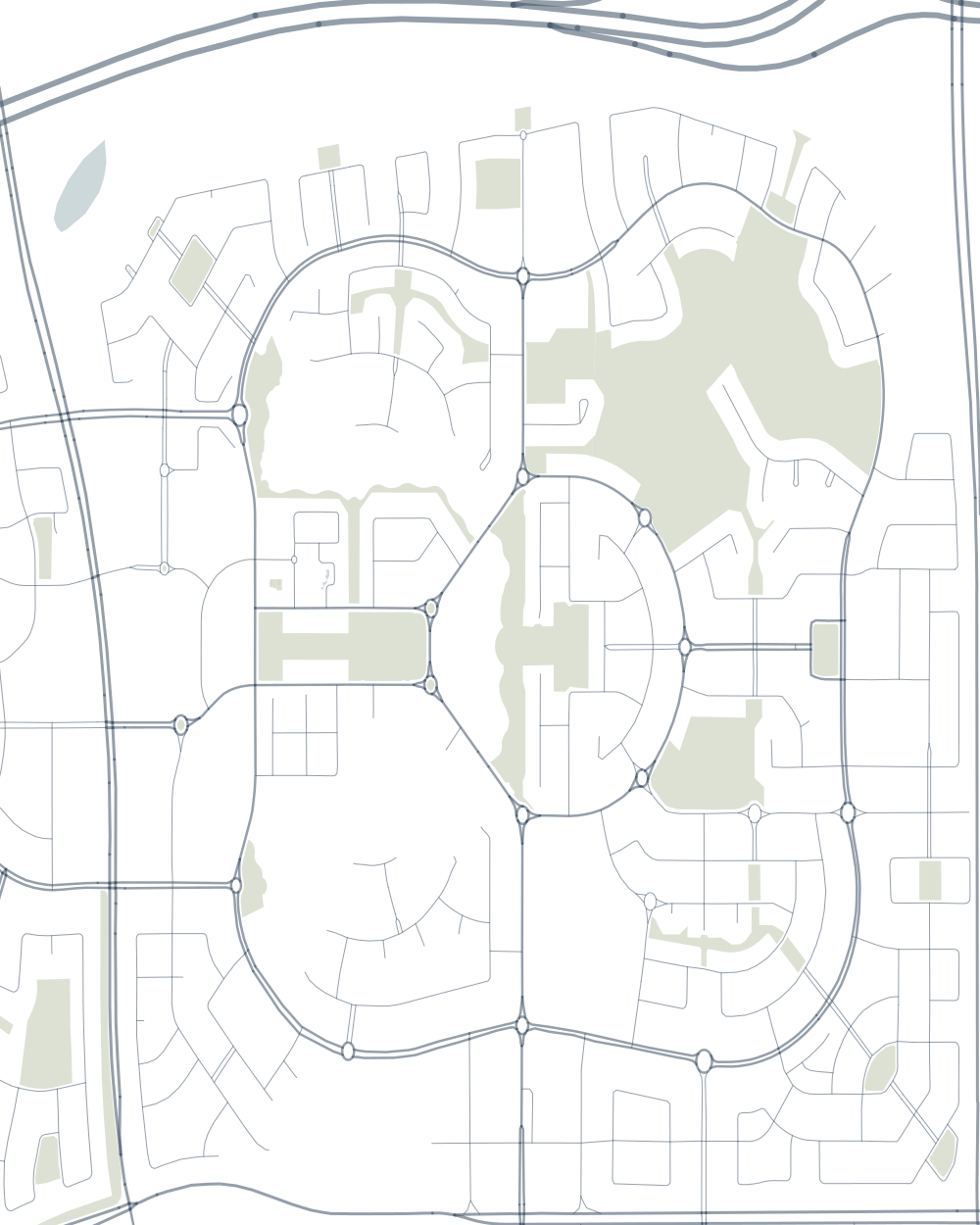
Mahogany sits in the City of Calgary’s southeast sector, in Ward 12, whose councillor is Mike Jamieson. The City’s statutory Mahogany Community Plan puts the community at approximately 525 hectares, or 1,300 acres, bounded on the north by the transportation utility corridor containing Marquis of Lorne Trail SE, on the south by 196 Avenue SE, on the east by the future East Freeway and on the west by 52 Street SE. The most recent official population count is 13,860, from the 2021 Census of Canada, alongside 4,715 occupied private dwellings. That figure is five years old and this community was building through the whole period, so treat it as a floor rather than a current headcount. Calgary’s civic census was discontinued after 2019, so there is nothing newer to reach for.
Build-out numbers exist but they are projections and they disagree. The City’s plan projects 21,000 people at build-out across six neighbourhood areas, and cautions that its own figures are a general guide that can be deviated from at a later planning stage. The developer markets a figure of nearly 25,000. Neither is a population today.
The thing that separates Mahogany from a community without a lake is not the water. It is the annual fee registered against the land title that pays for it, and the section below sets out what the association publishes about it and what it does not.
David’s take
The vibe
Everything the fee buys sits around one body of water, and the two parties who talk about it publicly do not fully agree on its size. The homeowners association, which owns and operates it, describes Mahogany Lake as 64 acres surrounded by 21 acres of parkland and calls it Calgary’s largest lake. The developer publishes 63 acres and attaches the same 21-acre figure to beach area instead of parkland. Both parties are selling something. The operator’s figure is given here with the operator’s name attached to it, and the superlative is left where it was found.
The City’s own statutory plan is the cleaner description of the arrangement, precisely because it is not marketing. It provides for a private recreation area containing a private man-made lake, describes it as a privately owned and self-supporting recreational amenity on a site owned and maintained by a residents association, and states that the lake is owned by and accessible to all residents living in Mahogany. It publishes no acreage at all.
There are two beach sites. West Beach, and the Central Beach site, which is home to the Beach Club. The association also refers to the Main Beach Clubhouse in its own copy while the developer uses Central Beach for the same location, so anyone reading both will see three names for two places.
The Beach Club is a 22,000 square foot building at 29 Masters Park SE. The association describes a dedicated skate room, a full-size gymnasium and multiple meeting rooms inside it, with outdoor fitness equipment, a splash park, tennis courts, an outdoor hockey rink and a summer skate park around it. Facility hours run 9:00 a.m. to 10:00 p.m. every day, closed Christmas, New Year’s Day and Good Friday, with boat rentals from 9:30 a.m. to 8:45 p.m. and boats due back by 9:15 p.m.
Two access rules here are worth knowing before you need them, because neither is guessable. Renting one of the Beach Club’s venue rooms does not include lake or lake-amenity access for you or your guests, and the rental has to end before anyone goes down to the water. And a resident may register up to eight guests at the main office for lake access.
Winter is on the association’s published list as much as summer. The encumbrance pays for ice resurfacing of the outdoor rink and of recreational ice areas on the lake, including a 2.4 km skating track, and the association’s lake operations page carries per-amenity winter statuses for foot traffic, ice fishing, pathways, lake rinks, skate ovals, crokicurl, bridges and the outdoor rink. The same fee list also covers annual restocking of the lake with trout, purchase and maintenance of self-propelled watercraft, beachfront maintenance, entryway features, lawn maintenance on association grounds, roadway-area landscape care, community events and life-cycle reserves. Because the association publishes lake and ice status live, a buyer can check conditions against the operator rather than against a listing remark.
The wetlands are not the lake
This is the distinction to get straight before a first summer here, because the two are not interchangeable. The swimming, boating and skating all belong to the lake. The wetlands are a separate feature with separate rules, and the developer’s own wetland brochure sets them out: swimming and wading are prohibited, because the water does not generally meet the standards of the Alberta Environmental Protection Act for primary contact, and skating and cross-country skiing on the wetland pond are not allowed, because the pond is not monitored for ice thickness. The City of Calgary is responsible for the function and maintenance of the wetlands after handover, which is consistent with the association’s own fee list covering winter ice and snow removal of city-owned wetlands and promenade areas. The association clears around them. Nobody skates on them.
Who pays, and what the association does not publish
The association’s wording on the obligation is universal. Every residential property in Mahogany has an encumbrance fee attached to the property land title, payable annually, defined in the association’s bylaws. There is no published exclusion list, and what the association says varies by property type is the rate rather than the obligation. One rate class is named in public, on the example invoice: laned.
On the amount, the association publishes one worked example and no schedule. Its own example invoice, dated December 28, 2025, shows $574.80 plus $28.74 GST, $603.54 in total, on a laned property. Four qualifications belong with that figure. It is a published example rather than a rate table. It is for a laned property and no other class. The document never names the fee year it belongs to, only the invoice date. And rates vary by property type with the schedule held behind a member login, so the amount attaching to a specific address is obtained by your lawyer through the Encumbrance Status Request, a form the association requires every law office to file to finalise a Mahogany sale. The fee fields on that form are marked including GST, so the number it comes back with is an all-in figure of the same kind as the $603.54 above, not a base to add tax to.
The billing calendar is published and, on one point, the association contradicts itself. The fiscal year runs January 1 to December 31 and invoices are issued in the first week of November through the member portal. The association’s own fee-schedule sheet then sets the payment deadline at December 31 with member access restricted from January 1 on unpaid accounts, while two of its web pages say the fee is due January 1. Both dates come from the association’s own published materials. What follows an unpaid account is not ambiguous: a 3% late interest penalty on February 1, another on March 1, a third plus a $70 administrative fee on April 1, and referral to legal collections on May 1. That $70 is a late-payment charge and is not the same thing as the one-time $75.00 resale administration fee a buyer pays. A three-month payment plan is available from the association, and annual increases or decreases are calculated from the Statistics Canada CPI index for Calgary, applied each September to set the following year’s fees.
Two other one-time amounts are published. A resale buyer pays a one-time administration fee of $75.00 including GST before membership access is issued. A tenant pays a one-time $65 rental lease administration fee, not charged again on renewal of the same lease at the same property.
The two organisations
The compulsory body is the Mahogany Homeowners Association, at 29 Masters Park SE. The voluntary one is the Mahogany Community Association, which charges $30 a year for a membership whose published perks are third-party retail and entertainment discounts, and which funds social events as a non-profit. The $30 does not buy lake access, and facility access is gated on the encumbrance being in good standing.
The homeowners association draws the line itself, which is the version worth quoting: homeowners associations are created by developers to oversee shared community-owned parks and facilities through fees paid by homeowners, and community associations are voluntary, resident-led organisations focused on community building and advocacy with the City. One more wrinkle for anyone searching. The Mahogany Community Association is new, having evolved at the end of 2024 out of the Copperfield Mahogany Community Association, a joint body covering two communities, so older material comes back under the earlier name.
Housing stock
The City’s own construction table is the place to start, because it is year-stamped and it settles what a build-era guess would only approximate. Of Mahogany’s 4,715 occupied private dwellings at the 2021 census, 1,890 were built between 2011 and 2015 and 2,445 between 2016 and 2021, so 92% of them went up in 2011 or later and 52% in the last six-year band alone. A further 325 date from 2001 to 2010, and a handful of records predate 1960. The sales data agrees: the homes that changed hands over the twelve months to August 2026 carried a median build year of 2018.
All four product types sold in enough volume this year to give a reliable typical price, which the single blended figure above does not show on its own.
Detached houses were the biggest of the four segments at 258 sales, 56.1% of the market, with a typical price of $755,000 and a full range from $505,000 to $2,800,000. The typical detached home that sold had a build year of 2016. Almost none of these sales reported a separate association fee, on top of the encumbrance fee every Mahogany title carries.
Apartments were 95 sales, 20.7% of the market, with a typical price of $364,000 and a full range from $226,000, the community floor, to $2,385,000. Typical condo fee on those sales was about $524 a month; confirm the exact figure in the condo documents before you buy. The apartments that sold had a typical build year of 2018.
Row and townhouse product was 58 sales, 12.6% of the market, with a typical price of $522,448 and a full range from $235,000 to $749,900. It is the newest product in the community by build year: the townhouses that sold had a typical build year of 2023. Typical condo fee on the sales that reported one, $267 a month.
Semi-detached homes were 49 sales, 10.7% of the market, with a typical price of $585,000 and a full range from $510,000 to $1,035,000, and a typical build year of 2018. Too few of these sales reported a condo fee to give a reliable figure.
One carrying cost applies across all four. The annual encumbrance fee is attached to every residential land title in Mahogany, and a condominium fee, where the property is a condominium, sits on top of it rather than in place of it.
| Type | Typical price | Notes |
|---|---|---|
| Detached | $755,000 | 258 sales (56.1% of all sales in the community) between $505,000 and $2,800,000, including the community top. Half sold within 28 days. Typical build year 2016. |
| Semi-detached | $585,000 | 49 sales (10.7% of all sales in the community) between $510,000 and $1,035,000. Half sold within 30 days. Typical build year 2018. |
| Row / townhouse | $522,448 | 58 sales (12.6% of all sales in the community) between $235,000 and $749,900. Half sold within 65 days. Typical condo fee $267 a month, typical build year 2023. |
| Apartment | $364,000 | 95 sales (20.7% of all sales in the community) between $226,000 and $2,385,000, including the community floor. Half sold within 48 days. Typical condo fee $524 a month, typical build year 2018. |
Recent sales
Pace first, since it varies more across segments than price does.
Half of Mahogany’s 460 sales sold within 35 days over the twelve months to August 2026, and at that same midpoint sellers took 98.26% of asking. Some listings sat considerably longer than that middle figure.
The segments do not move together. Detached sold within 28 days at the midpoint, semi-detached within 30, apartments within 48, and row and townhouse product within 65, more than double the detached figure. Whatever the community-wide number suggests, the segment you are buying or selling in is what actually sets your calendar.
On price, sellers gave up a little under two percent of asking, at a sale-to-list ratio of about 98.26%.
The typical (median) price across all 460 sales was $646,250, with half of everything closing between $541,000 and $815,000. The top of the market shows up in two places: the community’s highest sale was $2,800,000 in the detached segment, and the apartment segment reached $2,385,000.
Those four segments cover all 460 sales, which is why the table above is the place to start rather than any single community-wide figure. For help placing a specific home inside these bands, start with the buyer’s guide. On the selling side, a home valuation is the first step.
Getting around
Mahogany has no LRT station, and none is under construction anywhere near it.
The nearest station that exists today is Somerset-Bridlewood on the Red Line, 8,565 metres from Mahogany’s boundary as a straight line, not a walking distance. Shawnessy is the next nearest at 8,670 metres, measured the same way.
A station named Auburn Bay / Mahogany does exist on paper, and its published coordinates sit 31 metres outside the community boundary, in Auburn Bay. That figure is the easiest thing on this page to misread, so here is what it means and what it does not. It means a point on a future-extensions map is very close to the line. It does not mean anyone in Mahogany lives 31 metres from a train, and it does not mean a train is coming. The station appears only on the City’s Green Line Future Extensions page, the City’s open data records its construction stage as TBD, and no start date, no opening date and no funding commitment is published for it. The two numbers belong together: a planned station 31 metres away that does not exist, and the nearest one that does, 8,565 metres off.
What is funded is the Green Line’s SE Segment, ten stations from Shepard to downtown, with construction under way and a published opening of 2031. Shepard is that phase’s southern terminus, 3,704 metres from Mahogany’s boundary, and none of the ten funded stations is in Mahogany. Green Line planning was still in motion as this guide was written, so take the current position from the City’s own pages rather than from a property guide.
The bus network is four routes with stops inside the community. Route 75 Somerset - Mahogany is the main one at 19 stops inside the boundary, and it is the route that reaches the Red Line at Somerset Bridlewood Terminal. Route 79 Cranston / Mahogany has 13 stops inside and links Seton, Cranston, Mahogany and Auburn Bay without reaching an LRT station or terminal at either end. Route 23 52 St E has 5 stops inside and runs to Saddletowne Terminal and McKenzie Terminal. Route 302 BRT Southeast/City Centre reaches downtown, but it has only two stops inside Mahogany, both on 52 Street SE, so it runs along the community’s western edge rather than through it. Route 302 is classed as bus rapid transit and it is not one of Calgary Transit’s colour-branded MAX lines. No MAX-category stop falls inside Mahogany at all.
There is no park and ride in Mahogany or adjacent to it. Calgary Transit’s published list of facilities carries no Mahogany, Auburn Bay or Seton entry. At the ends of the routes that serve the community, Somerset-Bridlewood has 519 free stalls, 374 reserved, eight four-hour and twelve accessible, and McKenzie Towne has 522 free stalls and eight accessible.
None of the distances above convert into minutes: no drive times, no walking times, no service frequencies. Every figure here is a straight line to a boundary, not a route you would actually walk or drive. Check a live Calgary Transit schedule for frequencies, and drive your own commute before you commit to an address, at the hour you would actually be doing it.
Schools
Mahogany has two designated schools standing inside its own boundary, one on each board: Mahogany School and Divine Mercy School. Every other school in the pathway sits in a neighbouring community, and every designation below covers the whole of Mahogany. There is no split by address anywhere in this community.
On the public side the pathway starts at Mahogany School, Kindergarten to Grade 5, at 165 Mahogany Blvd SE, inside the community. From there it runs to Lakeshore School at 430 Auburn Bay Dr SE in Auburn Bay, grades 6 to 9, and then to Joane Cardinal-Schubert High School, grades 10 to 12, at 19480 45 St SE in Seton.
Lakeshore carries one wrinkle worth knowing. CBE lists its designation as two grade bands, Regular (6) and Regular (7-9), rather than one combined 6-9 line. Both describe the same designation for a Mahogany address, so if the grade you are enrolling sits at the seam, confirm it directly with the school.
On the Catholic side, Divine Mercy School at 228 Mahogany Blvd SE holds the elementary designation and is the second of the two schools physically inside Mahogany. Monsignor J.S. Smith School at 2919 Douglasdale Blvd SE holds the junior high designation, from Douglasdale.
Senior high on the Catholic side is a co-designation rather than a single school. The district designates All Saints High School at 729 Legacy Village Road SE, and Mahogany students also have the option of attending Bishop O’Byrne High School, alongside residents of Auburn Bay, Cranston and Seton. That is one designation offering a choice, not a boundary line dividing the community into two catchments, and the district’s boundary record does not give a separate address for Bishop O’Byrne. From the 2027-28 school year, CSSD moves Mahogany’s designated Catholic senior high to St. Carlo Acutis High School, the new CSSD high school in southeast Calgary due to open in fall 2027.
Now the caution that matters most in this community, and it is not about which school is designated. Divine Mercy’s district record carries a restricted-enrolment note: new K-9 students may be directed to Monsignor J.S. Smith School instead. A designation tells you which school an address belongs to. It does not by itself produce a seat in the building, and where a school is under restricted enrolment those two things can come apart. If the Catholic elementary placement is part of why you are buying in Mahogany, ask the district directly what the current position is for the year you would be enrolling.
Both boards reset designations by address and review them every year, so treat all of the above as a snapshot taken in August 2026 and get the live answer from CBE’s Find a School tool and the CSSD school finder before you commit to a purchase. The schools resource sets out how Calgary’s boundaries and choice programmes fit together.
Mahogany School
Public · K-5
The designated CBE elementary school for Mahogany, Kindergarten to Grade 5, at 165 Mahogany Blvd SE inside the community. It is one of only two designated schools that actually stand inside Mahogany. Confirm your address with the CBE Find a School tool before you buy.
Lakeshore School
Public · 6-9
The designated CBE middle school for Mahogany, grades 6 to 9, at 430 Auburn Bay Dr SE in Auburn Bay. CBE lists it as two grade bands, 6 and 7-9, but it is one designation covering the full range. Confirm your address and grade with the CBE Find a School tool.
Joane Cardinal-Schubert High School
Public · 10-12
The designated CBE senior high school for Mahogany, grades 10 to 12, at 19480 45 St SE in Seton. Designations are set by address and reviewed each year, so verify the current one with the CBE Find a School tool.
Divine Mercy School
Catholic · Elementary
The designated CSSD elementary school for Mahogany, at 228 Mahogany Blvd SE inside the community, and the second of the two designated schools that actually stand in Mahogany. It carries a restricted-enrolment note: new K-9 students may be directed to Monsignor J.S. Smith School instead, so a designation here is not a guaranteed seat. Confirm both with the CSSD school finder before you buy.
Monsignor J.S. Smith School
Catholic · Junior high
The designated CSSD junior high school for Mahogany, at 2919 Douglasdale Blvd SE in Douglasdale. It is also where new K-9 students may be redirected if Divine Mercy School cannot place them. Verify your pathway with the CSSD school finder.
All Saints High School
Catholic · Senior high
The designated CSSD senior high school for Mahogany, at 729 Legacy Village Road SE in Legacy. It is not the only senior high option for a Mahogany address: students may also choose Bishop O'Byrne High School, alongside residents of Auburn Bay, Cranston and Seton. From the 2027-28 school year, CSSD moves Mahogany's designated Catholic senior high to St. Carlo Acutis High School, the new CSSD high school in southeast Calgary due to open in fall 2027. Confirm the current boundary with the CSSD school finder.
Bishop O'Byrne High School
Catholic · Senior high
An option rather than a separate catchment. Students residing in Auburn Bay, Cranston, Mahogany or Seton have the choice of attending All Saints High School or Bishop O'Byrne High School. The district's boundary record does not give a separate address for this school. Take the choice, and the current boundary, to the CSSD school finder.
Frequently asked questions
How much is the Mahogany encumbrance fee, and is it mandatory?
It is mandatory, and the association publishes one worked example of the amount rather than a rate schedule. The Mahogany Homeowners Association states that every residential property in Mahogany has an encumbrance fee attached to the property land title, payable annually, and its own example invoice, dated December 28, 2025, shows an annual encumbrance fee of $574.80 plus $28.74 GST, $603.54 in total, on a laned property. Four qualifications travel with that figure and none of them is optional. It is the association’s own published example, produced to show members where to find their account number, and not a rate table. It is for a laned property, which is one of the association’s named fee classes. The document gives an invoice date but never names a fee year. And the association states that fee rates vary by property type without publishing the schedule that sets them, because the bylaws defining the rates sit behind a member login. The amount attaching to a specific address is therefore obtained by your lawyer, through the Encumbrance Status Request form that every law office has to file with the association to finalise a Mahogany sale. There is a second cost on a resale purchase: a one-time administration fee of $75.00 including GST, charged to the buyer, before membership access is issued. Tenants pay a one-time $65 rental lease administration fee instead.
What is the difference between the Mahogany Homeowners Association and the Mahogany Community Association?
One is compulsory and controls the lake. The other is voluntary and sells discounts. The Mahogany Homeowners Association, at 29 Masters Park SE, collects the annual encumbrance fee registered on land title and runs Mahogany Lake, the beaches, the Beach Club and the parks. The Mahogany Community Association charges $30 a year and describes what that buys as access to retail and entertainment deals, alongside funding social events as a non-profit. The $30 membership does not buy lake access. Lake access runs through the encumbrance and through it only, and the homeowners association restricts facility access where an account is not in good standing. The association draws the distinction itself: it describes homeowners associations as bodies created by developers to oversee shared community-owned parks and facilities through fees paid by homeowners, and community associations as voluntary resident-led organisations focused on community building and advocacy with the City. One more thing worth knowing if you are searching online. The Mahogany Community Association is new, having evolved at the end of 2024 from the Copperfield Mahogany Community Association, a joint body covering two communities, so older material will come back under the earlier name.
How much do homes cost in Mahogany?
Over the twelve months to August 2026, Mahogany recorded 460 residential sales at a typical (median) price of $646,250, with half of everything closing between $541,000 and $815,000 and individual sales running from $226,000 to $2,800,000. All four product types here sold in enough volume to give a reliable typical price. Detached houses, 258 of the 460 sales, had a typical price of $755,000. Apartments, 95 sales, had a typical price of $364,000. Row and townhouse product, 58 sales, had a typical price of $522,448, with a typical condo fee of $267 a month on the 46 sales that reported one. Semi-detached homes, 49 sales, had a typical price of $585,000. Those four segments cover all 460 sales. Two carrying costs sit outside those prices: the annual encumbrance fee, which every residential title in Mahogany carries, and a condo fee where the property is a condo. For a read on a specific property rather than on the community as a whole, a home valuation is the place to start.
How long do homes take to sell in Mahogany?
Half of Mahogany’s 460 sales sold within 35 days over the twelve months to August 2026. Some listings sat considerably longer than that. The segments do not move together on this measure, and the gap between them is worth planning around. Detached houses sold within 28 days at the midpoint, and semi-detached homes within 30. Apartments sold within 48 days. Row and townhouse product sold within 65 days, more than double the detached figure. On price, sellers gave up a little under two percent of asking, at a sale-to-list ratio of about 98.26%. Put the two together and the pace of a sale here depends more on what you are selling than on the community you are selling it in.
What schools serve Mahogany?
Two of the designated schools stand inside Mahogany and the rest sit in neighbouring communities, but every designation below covers the whole community, with no address-by-address split. On the public side the pathway is Mahogany School (K-5) at 165 Mahogany Blvd SE, inside the community, then Lakeshore School at 430 Auburn Bay Dr SE in Auburn Bay for the middle grades, then Joane Cardinal-Schubert High School (10-12) at 19480 45 St SE in Seton. Lakeshore’s designation is listed as two grade bands, Regular (6) and Regular (7-9), rather than one combined 6-9 line, though it is the same designation for a Mahogany address either way. On the Catholic side, Divine Mercy School at 228 Mahogany Blvd SE holds the elementary designation and is the second school physically inside Mahogany, Monsignor J.S. Smith School at 2919 Douglasdale Blvd SE holds the junior high one, and senior high is a co-designation rather than a single school: the district designates All Saints High School at 729 Legacy Village Road SE, with Mahogany students also able to choose Bishop O’Byrne High School, alongside residents of Auburn Bay, Cranston and Seton. From the 2027-28 school year, CSSD moves Mahogany’s designated Catholic senior high to St. Carlo Acutis High School, the new CSSD high school in southeast Calgary due to open in fall 2027. One caution carries real weight here. Divine Mercy’s district record is flagged for restricted enrolment, with new K-9 students liable to be directed to Monsignor J.S. Smith instead, so a designation is not a guaranteed seat. Both boards reset designations by address and review them yearly, so treat this as an August 2026 snapshot and get the live answer from CBE’s Find a School tool and the CSSD school finder before you commit.
Is the Green Line coming to Mahogany?
Not on any published timeline, and the distances in circulation make this easy to get wrong. A station called Auburn Bay / Mahogany appears on the City of Calgary’s Green Line Future Extensions page, and its published coordinates sit 31 metres outside Mahogany’s boundary, in Auburn Bay. That 31 metres is a straight line from the station point to the nearest point on the community boundary, not a walk from any front door, and the station does not exist. It is not part of the funded Phase 1, the City’s own open data records it at a construction stage of TBD, and no start date, no opening date and no funding commitment is published for it. What is funded is the SE Segment from Shepard to downtown, ten stations with a published opening of 2031, and Shepard is its southern terminus, 3,704 metres from Mahogany’s boundary measured the same way. None of the ten funded stations is in Mahogany. The nearest LRT station that exists today is Somerset-Bridlewood on the Red Line, 8,565 metres from the boundary in a straight line, and Route 75 Somerset - Mahogany is the bus that reaches it. Green Line planning was still moving as this guide was written, so check the City’s own pages for the current position rather than relying on a property page for it.
Can you swim or skate on Mahogany's wetlands?
No, and the wetlands and the lake are two different places with two different sets of rules. Swimming and skating belong to Mahogany Lake, which the homeowners association operates, restocks with trout and resurfaces for winter use, including a 2.4 km skating track alongside ice fishing, lake rinks, skate ovals and crokicurl. The wetlands are separate. The developer’s own wetland brochure states that swimming and wading are prohibited because the water does not generally meet the standards of the Alberta Environmental Protection Act for primary contact, and that skating and cross-country skiing on the wetland pond are not allowed because the pond is not monitored for ice thickness. The City of Calgary is responsible for the function and maintenance of the wetlands after handover, and the encumbrance fee pays for winter ice and snow removal around city-owned wetlands and promenade areas, which is consistent: the association clears the paths, and nobody skates on the pond. Two further rules on the lake side that a buyer would not guess. Renting a room at the Beach Club does not come with lake access, and the rental has to end first. And a resident may register up to eight guests at the main office for lake access.
Sales data current as of 2026-08-11. Includes 460 residential sales in Mahogany over the twelve months to August 2026. Source: Pillar 9 MLS® System. Copyright 2026 Pillar 9. All Rights Reserved.