Overview
Royal Oak’s market has one segment carrying most of the weight and two others trading a long way beneath it. Ninety-three of the community’s 152 residential sales over the twelve months to August 2026 were detached houses, 61.2% of everything that changed hands, at a typical $785,000. Apartments closed 27 sales at a typical $257,500, and row and townhouse product closed 25 at $458,500. Seven semi-detached sales closed as well, too few to give a reliable price, build year or fee for that segment. Those four counts account for all 152 sales with nothing left over.
The blended median across the whole community was $678,000, and half of everything sold between $453,000 and $815,000. That $362,000 band is easy to misread. It is not the range a detached house trades in. It is a picture of the product mix: the 25th percentile sits within $5,500 of the row and townhouse median, and the 75th sits $30,000 above the detached median. What stretches the band is the $527,500 distance between the detached median and the apartment median, not variation inside any one product type.
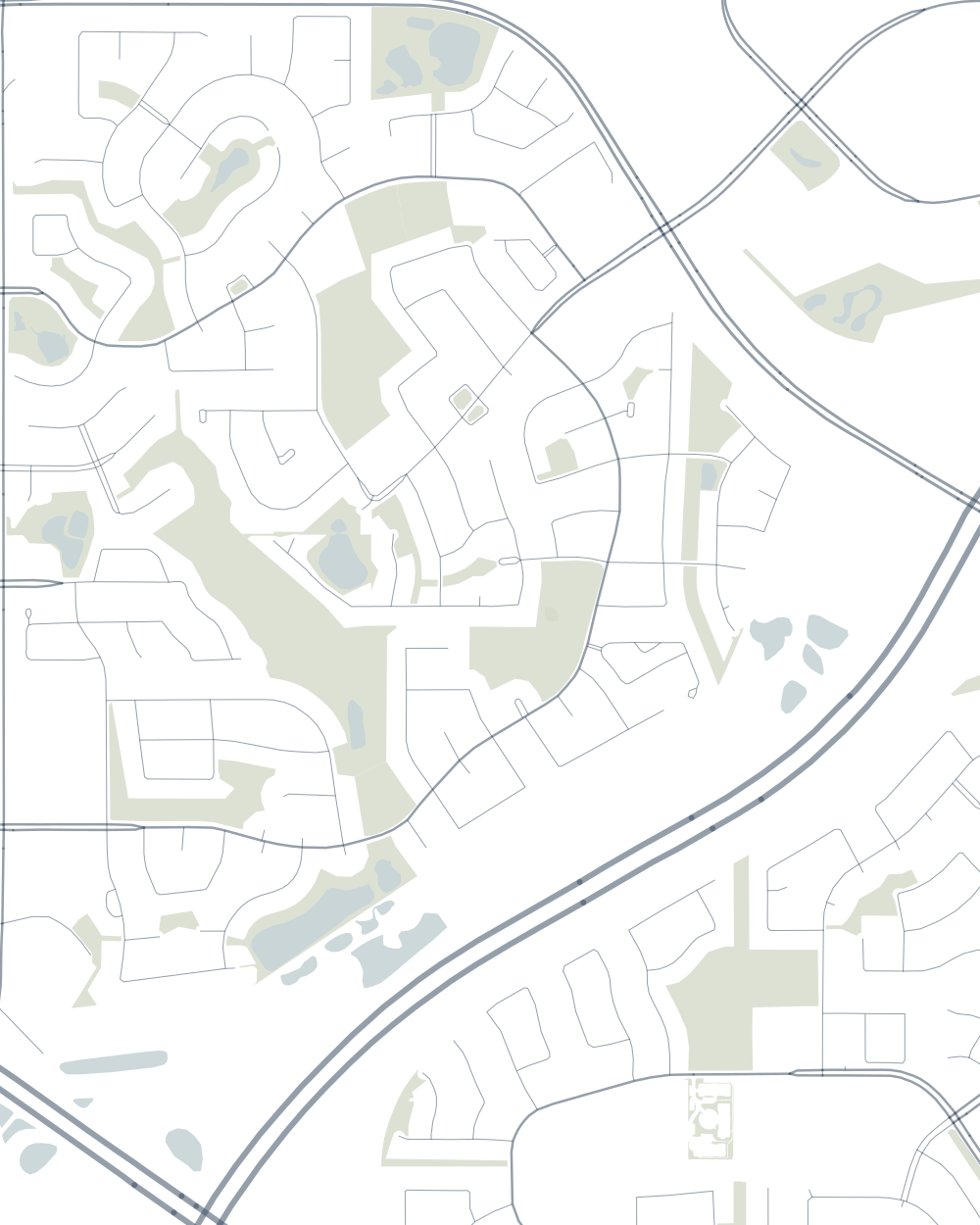
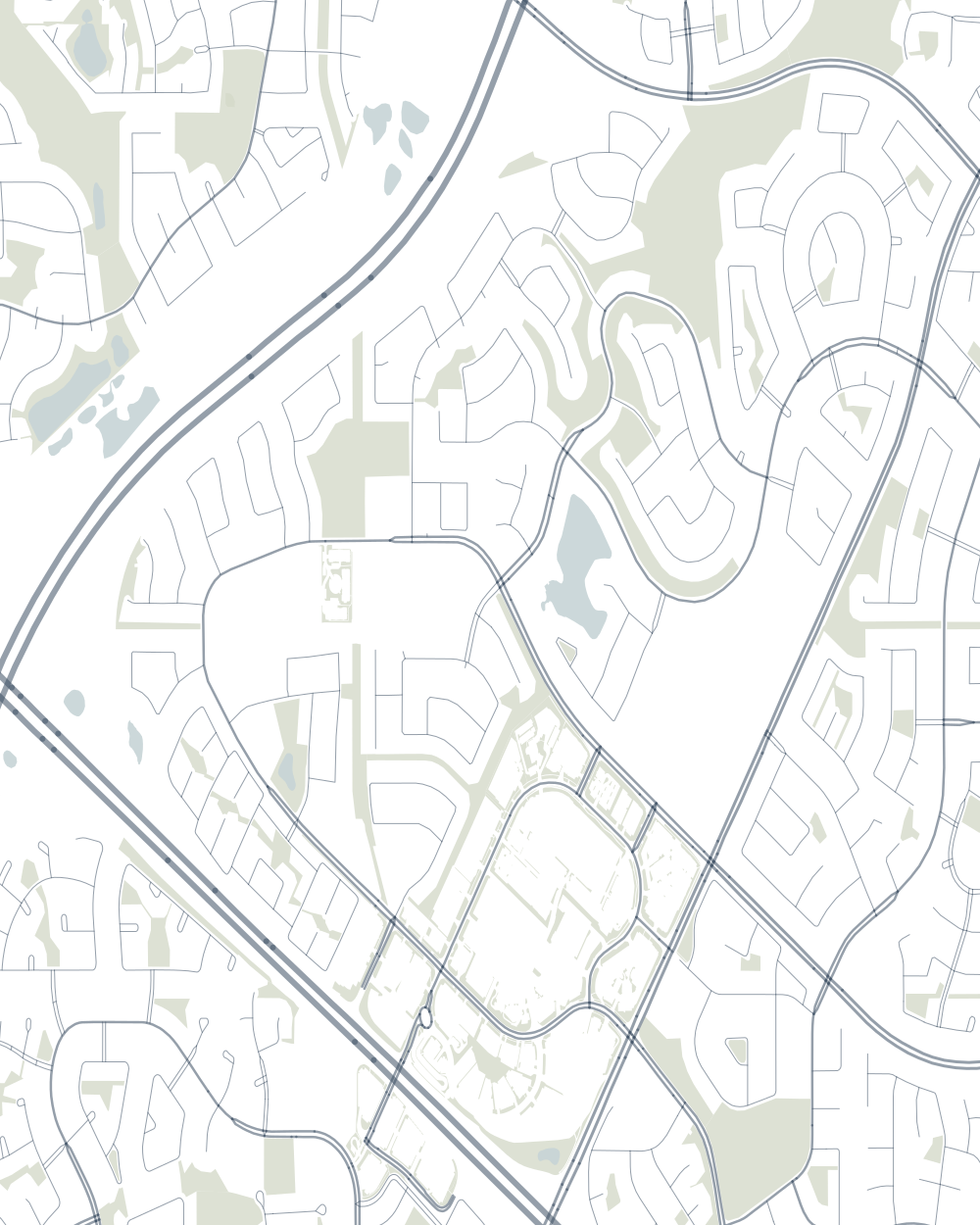
The City of Calgary files Royal Oak under community code ROY, in its Northwest sector, in Ward 1, across roughly 3.56 square kilometres bounded by Country Hills Boulevard NW on the north, Stoney Trail NW on the east, Crowchild Trail NW on the south and Rocky Ridge Road NW on the west. The land was annexed from the Municipal District of Rocky View in 1989. The City’s own records give the community three different status labels, so none is quoted here as definitive, and no published source names a developer for the community as a whole.
The other thing worth getting straight early is the annual charge people refer to as the Royal Oak fee. Royal Oak Estates, the part of the community where the question comes up, has a homeowners association, and it charges no fee. The enhanced landscaping there is funded instead by a City of Calgary special tax that arrives as a line on the property tax bill, created by petition of the property owners themselves. Restrictive covenants are registered against those same titles, and a covenant is a separate instrument from a tax. The section below sets out both.
David’s take
The vibe
The City’s own civic census series dates the community’s growth precisely, and it is a short, steep curve. Royal Oak counted 15 residents in 1987 and 56 in 1996. By 2001 it held 713, by 2005 it held 5,631, and by 2008 it held 9,910. The count settled at 11,687 by 2019, the last civic census the City ran. The 2021 federal census records 11,580 people in private households across 4,020 occupied private dwellings, and it puts 79% of those dwellings in the 2001 to 2010 construction band. Royal Oak was essentially built between 1999 and 2010, with the steepest years in the middle of that decade, and the sold homes behind the rest of this page carry a median build year of 2004, which lands squarely inside it.
The same profile puts single-detached houses at 71% of occupied dwellings, row houses at 11% and apartments in buildings under five storeys at 15%, with nothing at all five storeys or taller. Eighty-four per cent of dwellings are owner-occupied. Twenty per cent of residents are under 15, against 18% citywide, and 11% are 65 or older, against 13%. Median household income before tax in 2020 was $120,000, against $98,000 citywide. Read that 71% against the 61.2% detached share elsewhere on this page and note that they measure different things: what stands in the community today, and what sold in one twelve-month window.
One flood-risk fact worth stating plainly: no part of Royal Oak falls inside any of the City’s five flood maps, including the regulatory flood hazard map and the recorded extents of the June 2013 flood.
The charge in Royal Oak Estates is a tax, not an association fee
Royal Oak Estates has a homeowners association, and it charges no fee. The enhanced landscaping maintained there is funded through a City of Calgary special tax under the Enhanced Landscape Maintenance programme, levied under section 382(1) of Alberta’s Municipal Government Act and shown on the annual property tax bill as its own line. The association’s own account of how that came about is short: the property owners petitioned for a tax levy instead of association fees.
The City’s programme rules set out the mechanism. A non-profit representing the whole neighbourhood sponsors the programme and signs a landscape maintenance agreement with the City. Two thirds of property owners have to sign the petition. The City keeps paying an operating grant equal to its own base level of service, and the levy funds the increment above that. Each autumn the sponsoring organisation proposes the coming year’s rate, Council approves it by bylaw annually, and every five years the community holds a reaffirmation vote. Owners can also petition to discontinue it.
For Royal Oak Estates the levy was established in 2011 at the association’s request, and Bylaw 2M2026 sets the 2026 rate at $225.11 per parcel across 635 properties, unchanged from 2025. Schedule A of the bylaw lists the address ranges it covers, all of them on Royal, Royal Crest and Royal Ridge streets, and within that same schedule the 2026 landscape rates run from $50.33 per parcel up to Royal Oak Estates’ $225.11. What the money buys, in the City’s own description, is more grass cutting, flower planting, shrub maintenance, bed weeding and watering than the base level of service provides. The association’s own material names the features it maintains: entry gates, decorative brick and wrought iron fencing, a central park with a colonnade, a gazebo, a wet pond and circulating fountains.
Because the City collects it, it moves with the tax roll rather than an association’s billing calendar, and it is settled at closing the way property taxes are, not through an association transfer. And because Council sets it annually, $225.11 is the 2026 figure rather than a permanent one.
Restrictive covenants are a different instrument
Registered against Royal Oak Estates titles, separately from the tax, are restrictive covenants. The association’s own account is that they sit on the title of each house in the subdivision, put there to hold a consistent look across it. The two get treated as one thing constantly, and they are not. A tax collects money from an owner. A covenant restricts what an owner may do with the land, and it runs with the title to whoever buys next.
The covenant the association publishes was registered under Alberta’s Land Titles Act in December 1999 against a defined set of lots on one subdivision plan, by the company that developed them, Citiland Rocky Ridge Venture Inc. Its terms are concrete: development has to conform to architectural control guidelines the developer sets, front yard fences are strictly prohibited, satellite dishes and similar devices over 18 inches in diameter are prohibited outright, and fences the developer built cannot be replaced or altered in material or design and have to be kept in repair consistent with the original. Enforcement, by the document’s own wording, rests with the developer and with the owners of the other lots.
One clause in it is worth reading twice. In 1999 the covenant gave notice that a residents’ or homeowners’ association would be created at some point and might require owners to contribute an association fee or a membership fee. What turned up instead, twelve years later, was a municipal levy. The document that put the idea of a fee onto the title is the same document that is not a fee.
Because that instrument is scoped to specific lots on a specific plan, the terms that would bind you are the ones registered against the title you are actually buying. Have your lawyer pull the registered instrument during your condition period rather than working from a description of it.
RRROCA and what sits inside the boundary
The community association covering both Royal Oak and neighbouring Rocky Ridge is the Rocky Ridge Royal Oak Community Association, RRROCA. Its own wording is unambiguous: a volunteer organisation with voluntary membership, $30 per household, valid January 1 to December 31, and not an entity of the homeowners associations inside the two communities. Nothing about it touches a title. It runs no hall or building of its own. What it does operate is a 65 by 150 foot lit hockey rink with boards and fencing, on reserve land beside William D. Pratt School under a fifteen year lease from the City, alongside community programming and a spring sports programme for children.
Two practical notes follow from the two-community structure. The boundaries the Federation of Calgary Communities publishes for RRROCA describe the combined association area and reach west past Royal Oak’s own edge, so they are not a description of this community’s boundary. And RRROCA’s own site notes that a number of homeowners and residents associations operate within Rocky Ridge and Royal Oak, separately from the community association, naming the Cascades in Royal Oak Residents Association among them. What that association currently charges is not published in any reliable source. If you are buying in the Cascades, that number comes from the seller’s disclosure, the information certificate and the title search.
Inside the boundary itself the City records 22 titled park parcels, two of them district parks and four neighbourhood parks, plus 184 pathway segments running through the community, 31 of them carrying the City’s greenway flag. Those segments come to roughly 11.5 kilometres of pathway. One community park is a joint-use site shared between Royal Oak School, William D. Pratt School and RRROCA. There are no off-leash areas inside the community, and the City’s community-services file records no library, community centre or attraction within it.
The nearby facilities most people associate with Royal Oak are, on the City’s own geometry, just outside it. The Shane Homes YMCA at Rocky Ridge, which opened in January 2018 with a 25 metre competition pool, a leisure pool, ice surfaces, three gymnasiums, a running track, a theatre and a public library branch, sits roughly 337 metres north of the boundary on a parcel the City places in neither Royal Oak nor Rocky Ridge. The Royal Oak Centre retail node at 8888 Country Hills Blvd NW sits in Royal Vista, about 117 metres outside. The commercial node genuinely inside the community is at 500 Royal Oak Dr NW, where ten active commercial licences are registered under Royal Oak, including a pharmacy, a veterinary clinic, a liquor store, restaurants and a physiotherapy and chiropractic clinic.
Housing stock
Four product types traded here, and three had enough sales for a reliable typical price. The gap between the highest of those three and the lowest is what gives this market its shape.
Detached houses were 93 sales, 61.2% of the market, at a median of $785,000. Those homes carried a median build year of 2004, and they took a median of 20 days to sell.
Row and townhouse product was 25 sales, 16.4% of the market, at a median of $458,500, with a median monthly association fee of $363.92 reported on those sales, a median build year of 2004 and a median of 26 days on market.
Apartments were 27 sales, 17.8% of the market, at a median of $257,500, with a median monthly association fee of $425.37, a median build year of 2007 and a median of 39 days on market. The apartment stock here is low-rise: the 2021 census records 15% of the community’s occupied dwellings as apartments in buildings under five storeys and none at all in buildings five storeys or taller.
Semi-detached homes accounted for the remaining seven sales, 4.6% of the market. That is too few sales to give a reliable price, build year or fee for the segment, so only the count is given here.
| Type | Typical price | Notes |
|---|---|---|
| Detached | $785,000 | 93 sales (61% of all sales in the community). Half sold within 20 days. Typical build year 2004. |
| Row / townhouse | $458,500 | 25 sales (16% of all sales in the community). Half sold within 26 days. Typical association fee $364 a month, typical build year 2004. |
| Apartment | $257,500 | 27 sales (18% of all sales in the community). Half sold within 39 days. Typical association fee $425 a month, typical build year 2007. |
| Semi-detached | Too few sales | Only 7 sales, not enough for a reliable price. |
Recent sales
Royal Oak reports timing by segment as well as community-wide, and the segment order is the more useful of the two.
Detached houses, the most expensive segment on the page at a $785,000 median, moved through a median of 20 days. Row and townhouse product took 26 days, landing exactly on the community-wide middle. Apartments, the least expensive segment at $257,500, took 39 days. In this community over this window, the product at the top of the price ladder was also the one that cleared quickest, and the product at the bottom of it sat longest. That is worth carrying into an expectation about how long a listing should take, because the community-wide figure alone would set the same expectation for all three.
Community-wide, half of all sales closed within 26 days, and the average across all 152 sales was 35 days, the figure shown in the stat block at the top of this page. A nine day gap in that direction is the usual shape: a handful of listings that sat well past the midpoint pull the average past it.
The price pair runs the other way, and it is the less common direction. The blended median was $678,000 against a mean of $648,062, so the mean lands $29,938 under the median. Both numbers describe the same 152 sales, they just answer different questions. Sort every sale from low to high and the median is whichever one takes the middle seat. The mean pools all the money and divides it by the count, so it follows where the dollars sit rather than where the middle sale sits. In Royal Oak the pool is weighted downward: the two segments trading below the community median sit a long way below it, apartments by $420,500 and row and townhouse by $219,500, while the segment above it sits only $107,000 over. Fifty-two of the 152 sales come from those two lower segments, which is enough weight to settle the mean under the middle seat. The remaining seven sales, not broken out separately, are too few to move it far either way.
Half of everything sold between $453,000 and $815,000, and the full range for the year ran from $200,000 to $1,498,784. Sellers held onto 98.01% of asking at the median, giving up a shade under two per cent at the midpoint.
Not one of the figures above prices a house. To arrive at them at all, Royal Oak has to be averaged across a $785,000 detached median and a $257,500 apartment median, which is a wide thing to be standing in the middle of. For a read on a specific property, a home valuation is the first step. On the buying side, the buyer’s guide is a useful next stop.
Getting around
No CTrain station stands inside Royal Oak, and the nearest one misses by a distance that is easy to misread. Tuscany Station on the Red Line sits roughly a hundred metres outside Royal Oak’s western boundary, which puts it in Tuscany. Either way it is a short distance on a map and not a short walk for most of the community, which runs 3.56 square kilometres east of that line. Royal Oak has no park and ride of its own either. Crowfoot Station is the next nearest at about 2.43 kilometres, and it sits inside Scenic Acres. There is no City community called Crowfoot at all, which is worth knowing if a listing describes the station that way.
Four regular Calgary Transit routes have stops inside the community, 34 active stops between them. Route 138 Citadel carries the most at 19 stops, Route 158 Royal Oak has 13, Route 115 Symons Valley Parkway has 7, and Route 169 Rocky Ridge has 2. All four serve the Tuscany Station and Rocky Ridge Terminal interchange, so the practical route to the Red Line from a Royal Oak address is a bus first. Route 138 also reaches Crowfoot Station and Citadel Terminal, and Route 115 also reaches North Pointe Terminal.
A further five routes with stops inside the boundary are categorised by the City as school specials, numbered 773, 774, 801, 814 and 817. They run one or two trips on school days, timed to bell schedules, and they should not be counted as transit coverage when you are assessing an address. Their names are a useful cross-check on the schools section further down: Route 801 is Brebeuf/RoyalOak/RockyRidge, and St. Jean Brebeuf is Royal Oak’s designated Catholic junior high, sitting outside the community in Brentwood. The transit network and the catchment map agree with each other.
The census puts numbers on what that adds up to. In 2021, 8% of Royal Oak’s employed labour force commuted by transit, against 9% citywide, and 80% drove. Sixty per cent of commutes ran under 30 minutes.
Driving is the mode this community is built around, and its edges say why. Stoney Trail and Crowchild Trail are both skeletal roads in the City’s own classification, and both of them touch Royal Oak’s southern edge, with Stoney Trail also running up the east side and Country Hills Boulevard, an arterial, across the north. Royal Oak fronts Stoney Trail directly, and the final stretch of the West Calgary Ring Road opened on 19 December 2023, completing the ring.
The drive times in the commute table at the foot of this page were measured from the community centroid with traffic modelling switched off, so read them as free-flow times rather than as a typical morning. Downtown, meaning the Municipal Building specifically, is 22.8 kilometres and 25 minutes on that basis. The University of Calgary is 15.8 kilometres and 16 minutes, Foothills Medical Centre 17.7 kilometres and 17 minutes, and the airport 25.8 kilometres and 20 minutes. Add your own allowance for rush hour. The City’s traffic data records volumes rather than delay, and a volume count is not a measure of how long a trip actually takes.
Schools
Six designated schools serve a Royal Oak address. Two stand inside the boundary and four do not, and the divide falls in a tidy place: the public elementary and middle schools are here, and everything after them is somewhere else. Every school below is the designation for the whole community, with no split anywhere in it. Attendance areas reflect the 2025/2026 school year.
The public pathway, and where it leaves the community
Royal Oak School, at 9100 Royal Birch Blvd NW, holds the CBE elementary designation and sits inside the community. William D. Pratt School, at 9850 Royal Oak Way NW, holds the middle-school designation and also sits inside it.
Where the handover between the two falls is worth planning around. The designation runs kindergarten through grade 4 at Royal Oak School and picks up at grade 5 at William D. Pratt, so the change of buildings happens at the end of grade 4. A family arriving from a community whose elementary school runs to grade 5 is moving a child a year sooner than they may be expecting.
Two grade figures exist for each of these buildings and they do not agree, so it is worth knowing which one applies to your address. CBE’s school profile for Royal Oak School advertises K-6, wider than the K-4 that the designation gives for a Royal Oak address, and the same mismatch turns up at William D. Pratt. A published span says what grades a building teaches. A designation says which addresses belong to it. Those are two different questions, and the grades listed on this page are the designated ones. If the grade you are enrolling falls near the seam, take it to CBE rather than reading it off a span.
Senior high is Robert Thirsk High School, at 8777 Nose Hill Dr NW, in Arbour Lake. It is the designation for a Royal Oak address and it stands outside the community.
The Catholic pathway, all of it outside
All three CSSD designations sit outside Royal Oak. St. Maria Goretti School, at 375 Hawkstone Drive NW, holds the elementary designation from Hawkwood. St. Jean Brebeuf School, at 5030 Northland Drive NW, holds the junior high designation from Brentwood. Senior high is St. Francis High School, at 877 Northmount Drive NW, over in Collingwood. From the 2027-28 school year, the designated Catholic senior high becomes St. Pier Giorgio Frassati High School, the new CSSD school in west Calgary due to open in fall 2027.
Put together, four of the six designated schools serving a Royal Oak address stand somewhere other than Royal Oak, including the entire Catholic pathway and the public senior high. That is not a criticism of the community and it is not unusual in Calgary. It is a planning fact: only the kindergarten-through-grade-9 public pathway is a walk within the boundary, and everything after it involves leaving.
Both boards reset and review designations by address annually, so treat everything above as a snapshot of the 2025/2026 attendance areas taken in August 2026, and get the live answer from CBE’s Find a School tool and the CSSD school finder before you commit to a purchase. The schools resource sets out how Calgary’s boundaries and choice programmes fit together.
Royal Oak School
Public · K-4
The designated CBE elementary school for Royal Oak, at 9100 Royal Birch Blvd NW, inside the community. CBE's school profile states a wider K-6 span for the building; K-4 is the designated grade range for a Royal Oak address. Attendance areas reflect the 2025/2026 school year. Verify your specific address with the CBE Find a School tool before you buy.
William D. Pratt School
Public · 5-9
The designated CBE middle school for Royal Oak, at 9850 Royal Oak Way NW, inside the community, covering grades 5 to 9. CBE's published span for the building itself does not match the designated grade range; the designation is what applies to a Royal Oak address. Attendance areas reflect the 2025/2026 school year. Verify your address with the CBE Find a School tool.
Robert Thirsk High School
Public · 10-12
The designated CBE senior high school for Royal Oak, at 8777 Nose Hill Dr NW, in Arbour Lake rather than in Royal Oak itself. Designations reflect the 2025/2026 school year. Verify your address with the CBE Find a School tool.
St. Maria Goretti School
Catholic · Elementary
The designated CSSD elementary school for Royal Oak, at 375 Hawkstone Drive NW, in Hawkwood rather than in Royal Oak itself. Attendance areas reflect the 2025/2026 school year. Verify your specific address with the CSSD school finder before you buy.
St. Jean Brebeuf School
Catholic · Junior high
The designated CSSD junior high school for Royal Oak, at 5030 Northland Drive NW, in Brentwood rather than in Royal Oak itself. Attendance areas reflect the 2025/2026 school year. Verify your address with the CSSD school finder.
St. Francis High School
Catholic · Senior high
The designated CSSD senior high school for Royal Oak, at 877 Northmount Drive NW, in Collingwood, the third of Royal Oak's three Catholic designations to sit outside the community. From the 2027-28 school year, the designated Catholic senior high becomes St. Pier Giorgio Frassati High School, the new CSSD school in west Calgary due to open in fall 2027. Designations reflect the 2025/2026 school year and are reset annually, so confirm yours with the CSSD school finder.
Frequently asked questions
How much do homes cost in Royal Oak?
Over the twelve months to August 2026, Royal Oak had 152 residential sales. The typical price was $678,000, with half of everything closing between $453,000 and $815,000, and sales overall ranging from $200,000 to $1,498,784. Detached houses were 93 of those 152 sales, a typical $785,000, with half selling within 20 days. Row and townhouse sales, 25 of them, were a typical $458,500 within 26 days, with a typical monthly association fee of $363.92. Apartments, 27 sales, were a typical $257,500 within 39 days, with a typical monthly association fee of $425.37. The remaining seven sales were semi-detached, too few to give a reliable typical price. None of these figures prices a particular address, which is what a home valuation is for.
Does Royal Oak have a mandatory homeowners association fee?
There is no community-wide association fee in Royal Oak, and the distinction between what does exist here and an association fee is worth getting right before you budget for one. The Rocky Ridge Royal Oak Community Association, RRROCA, covers both Royal Oak and neighbouring Rocky Ridge, and its own wording describes a volunteer organisation with voluntary membership at $30 per household, valid January 1 to December 31, with nothing registered against a title. Royal Oak Estates does have a homeowners association, and it charges no fee. What exists there instead is a City of Calgary special tax for enhanced landscape maintenance: a municipal levy created by petition of the property owners, authorised annually by bylaw, and collected on the property tax bill rather than invoiced by any association. For 2026 the rate is $225.11 per parcel across 635 properties under Bylaw 2M2026, unchanged from 2025, and the bylaw’s own schedule sets out the address ranges it covers. Obligations elsewhere in the community sit at subdivision level rather than community level, and RRROCA’s own list of them describes the major ones rather than all of them, so a specific address is settled by the title search and the seller’s disclosure rather than by a community page.
What are the restrictive covenants on a Royal Oak Estates title?
Restrictive covenants are registered against Royal Oak Estates titles, and they are a different instrument from the special tax, doing a different job. A tax collects money. A covenant restricts what an owner may do with the property, and it binds whoever holds the title next. The registered covenant the homeowners association publishes was filed under Alberta’s Land Titles Act in December 1999 against a defined set of lots on one subdivision plan, by the company that developed them, Citiland Rocky Ridge Venture Inc. Its terms are concrete: development has to conform to architectural control guidelines the developer sets, front yard fences are strictly prohibited, satellite dishes and similar devices over 18 inches in diameter are prohibited outright, and fences the developer built cannot be replaced or altered in material or design and have to be kept in repair. That same document gave notice back in 1999 that an association might one day require owners to contribute a fee, which is a large part of why the levy and the covenants get conflated today. Because the instrument is scoped to particular lots on a particular plan, the terms that would bind you are the ones registered against the title you are buying. Ask your lawyer for the registered instrument during your condition period, and read it before the condition day rather than after.
Why does half of Royal Oak's market sit between $453,000 and $815,000?
Because that band measures the community’s product mix, not the price range of any one product type. Sort all 152 sales from low to high and the middle half of them falls between $453,000 and $815,000, a $362,000 spread. Read as a detached range that looks enormous, and it is not a detached range. The 25th percentile sits within $5,500 of the row and townhouse median of $458,500, and the 75th sits $30,000 above the detached median of $785,000. What stretches the band is the $527,500 distance between the detached median and the apartment median of $257,500. If you are shopping one product type, the segment medians are the figures to use and the community band is context around them.
What schools serve Royal Oak?
Six designated schools serve a Royal Oak address, and two of them stand inside the community. On the public side, Royal Oak School at 9100 Royal Birch Blvd NW holds the CBE elementary designation and William D. Pratt School at 9850 Royal Oak Way NW holds the middle-school designation, both inside the boundary. Note where the handover falls: the designation runs kindergarten to grade 4 at Royal Oak School and picks up at grade 5 at William D. Pratt, so a child here changes buildings at the end of grade 4. Senior high is Robert Thirsk High School at 8777 Nose Hill Dr NW, in Arbour Lake, outside Royal Oak. All three Catholic designations sit outside the community as well: St. Maria Goretti School at 375 Hawkstone Drive NW in Hawkwood, St. Jean Brebeuf School at 5030 Northland Drive NW in Brentwood, and St. Francis High School at 877 Northmount Drive NW in Collingwood. From the 2027-28 school year, the designated Catholic senior high becomes St. Pier Giorgio Frassati High School, the new CSSD school in west Calgary due to open in fall 2027. There is no split anywhere in this community; each school is the designation for the full boundary. Attendance areas reflect the 2025/2026 school year, and both boards review designations by address annually, so confirm a specific address with CBE’s Find a School tool and the CSSD school finder before you commit to a purchase.
Is Robert Thirsk High School in Royal Oak?
No. Robert Thirsk High School is the CBE senior high designation for a Royal Oak address, which is a different statement from being located here. The school itself, at 8777 Nose Hill Dr NW, sits in Arbour Lake, not Royal Oak. A designation tells you which school your address belongs to. It says nothing about how far away the building is or which community it stands in, and those are the two things a family planning a walk or a bus route actually needs. The same caution runs the other way as well: a school with a community’s name on it is not evidence that it sits inside that community, and a school inside a community is not automatically its designated school.
Does Royal Oak have a CTrain station?
No CTrain station sits inside Royal Oak. The nearest is Tuscany Station on the Red Line, about a hundred metres outside Royal Oak’s western boundary, in Tuscany. Crowfoot Station is the next nearest at about 2.43 kilometres, and it sits in Scenic Acres rather than in any community of its own. Four regular Calgary Transit routes have stops inside the community: Route 158 Royal Oak with 13 stops, Route 138 Citadel with 19, Route 115 Symons Valley Parkway with 7, and Route 169 Rocky Ridge with 2. All four serve the Tuscany Station and Rocky Ridge Terminal interchange, so a resident without a car reaches the Red Line by bus rather than on foot. A further five routes with stops inside the boundary are categorised by the City as school routes, timed to bell schedules, and they are not a general commute option. In the 2021 census, 8% of Royal Oak’s employed labour force commuted by transit against 9% citywide, and 80% drove.
Is the Shane Homes YMCA at Rocky Ridge in Royal Oak?
No, though it is close. The facility’s coordinates at 11300 Rocky Ridge Rd NW sit roughly 337 metres north of Royal Oak’s nearest boundary point, on an undeveloped parcel that the City’s own boundary file places in neither Royal Oak nor Rocky Ridge. Two other nearby names carry the same trap. The Royal Oak Centre retail node at 8888 Country Hills Blvd NW sits in Royal Vista, roughly 117 metres outside the boundary, and every business licence registered at that address is filed by the City under Royal Vista rather than Royal Oak. The nearest fire station, at 16 Royal Vista Way NW, is likewise in Royal Vista, even though a community field in the City’s own fire-station file reads Royal Oak. The commercial node that is genuinely inside the community sits at 500 Royal Oak Dr NW, where ten active commercial licences are registered under Royal Oak, among them a pharmacy, a veterinary clinic, a liquor store, restaurants and a physiotherapy and chiropractic clinic.
How long do homes take to sell in Royal Oak?
Half of Royal Oak’s sales closed within 26 days over the twelve months to August 2026, and the average across all 152 sales was 35 days, the figure shown in the stat block at the top of this page. The nine day gap is the usual pattern: a few slower listings pull the average above the midpoint. Timing also varies by price segment, and the order is worth knowing before you set expectations. Detached houses, the most expensive segment at a typical $785,000, sold within 20 days. Row and townhouse product took 26 days, matching the community-wide midpoint exactly. Apartments, the least expensive segment at $257,500, took the longest at 39 days. At the typical sale, sellers held onto 98.01% of their asking price.
Sales data current as of 2026-08-31. Includes 152 residential sales in Royal Oak over the twelve months to August 2026. Source: Pillar 9 MLS® System. Copyright 2026 Pillar 9. All Rights Reserved.
Commute times
| Downtown | 25 min |
|---|---|
| University of Calgary | 16 min |
| Foothills Hospital | 17 min |
| Airport (YYC) | 20 min |